
Lesson 7.1: Real-World Scenarios
Case Studies in Neuro-Affirming Coaching
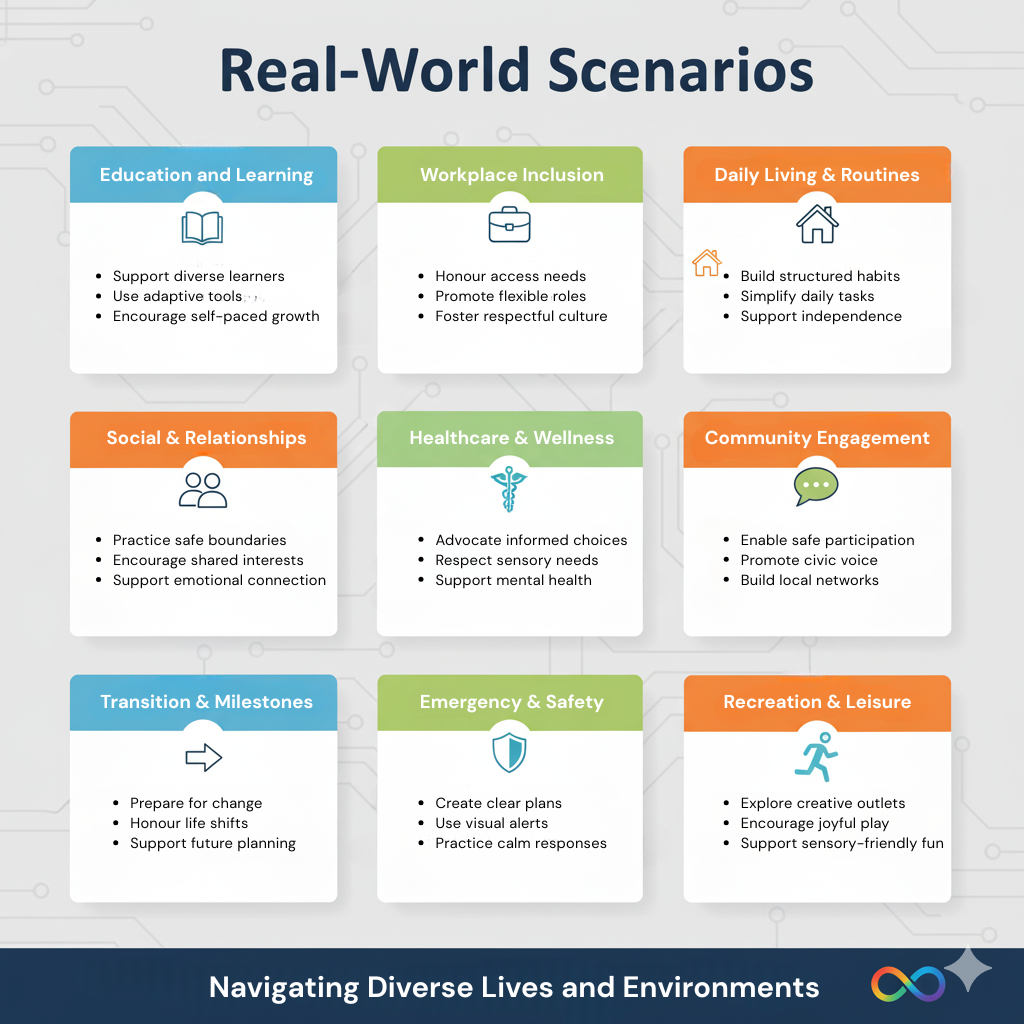
Welcome to Lesson 7.1. This module applies your coaching principles, communication strategies, and neuro, affirming framework to real, world case studies. Each scenario demonstrates how to transform challenges into opportunities for empowerment.
Key Concepts and Learning Guide
You have now acquired a comprehensive toolkit of foundational knowledge, communication strategies, and coaching principles across previous modules. This module focuses on applying that knowledge to real, world scenarios. You will analyse case studies to identify not just barriers, but also opportunities to demonstrate the strengths, based principles of neuro, affirming coaching and the Dynamic Development Plan (DDP).
Teaching Point: From Theory to Impact
The difference between a competent coach and an excellent coach lies in the ability to move from surface description (“what is happening?”) to deeper understanding (“why might this be happening in this context?”) and then to collaborative action (“how can we respond in a way that honours the client’s neurotype?”).
In each case study, you are invited to:
- Map the scenario onto the DDP process – from the client’s ‘Why’, to strengths, challenges, actions, and supports.
- Differentiate between individual traits and environmental mismatch – recognising that many “difficulties” arise from contexts designed around neurotypical norms.
- Design neuro-affirming interventions – grounded in autonomy, collaboration, and strengths, based practice.
Common Missteps to Avoid in Case Analysis
- Pathologising difference – describing the client as the problem, rather than exploring how context, expectations, and systems contribute.
- Jumping to solutions – prescribing strategies without first understanding the client’s ‘Why’, sensory profile, or lived experience.
- Ignoring power and autonomy – designing actions for the client rather than co, creating them in partnership.
- Focusing only on deficits – failing to explicitly identify and work with strengths, interests, and existing coping strategies.
The case studies below are not “perfect solutions” but models to help you practise the analytical and reflective thinking that sits at the heart of neuro, affirming coaching.
Case Study 1: The Creative with Communication Challenges
Focus: Communication, meetings, ADHD, auditory processing, double empathy.
Client Profile: A highly creative graphic designer with ADHD who struggles in team meetings. They are perceived as disengaged or distracted, leading to misunderstandings. Their innovative ideas often go unheard due to difficulty articulating them quickly in group discussions.
The Coaching Challenge: The client’s communication style and processing speed are poorly matched with fast, paced verbal meetings designed around neurotypical norms. This contextual mismatch, rather than a lack of ability, contributes to anxiety, frustration, and a sense of being overlooked.
- Non, linear thinking and difficulty with traditional executive function demands
- Auditory processing differences and vulnerability to sensory overload
- Delayed verbal processing and social anxiety in group settings
The Neurocoach’s Impact: Applying radical clarity and double empathy from Module 3, the coach supports the client to develop a short script explaining their communication preferences. Together they agree strategies such as submitting ideas in writing before meetings and requesting clear agendas. Mapped to the DDP, the client’s ‘Why’ (to have their ideas heard) is linked with strengths (creativity, visual thinking) and concrete actions (written contributions, structured turn, taking), resulting in greater confidence, visibility, and collaboration.
Case Study 2: The Meticulous but Overwhelmed Professional
Focus: Sensory regulation, masking, boundaries, self, advocacy, ethics.
Client Profile: An autistic project manager known for precision and structure. Despite exceptional organisational skills, they are experiencing burnout from sensory overload and prolonged masking in the workplace.
The Coaching Challenge: The client is using significant energy to conceal sensory and social differences in a demanding environment. The issue is not a lack of resilience, but a workplace that does not recognise or accommodate their sensory and communication needs. They worry that requesting adjustments will be seen as weakness or unprofessionalism.
- Detail, oriented, systems thinker with high accuracy
- Sensory overload and cumulative fatigue
- Masking and difficulty reading social cues
- High emotional sensitivity and fear of being judged
The Neurocoach’s Impact: Drawing on autonomy and unconditional positive regard from Module 4, the coach validates the client’s experience and reframes accommodations as a right rather than a privilege. Together, they co, create a self, advocacy plan based on the DDP, including scheduled sensory breaks, options for hybrid working, and noise, cancelling aids. The client’s ‘Why’ (to sustain performance without burnout) is linked to strengths (reliability, precision) and balanced with structural supports, reducing exhaustion and enhancing wellbeing.
Case Study 3: The Entrepreneur with Executive Function Challenges
Focus: Executive function, time blindness, visual planning, co, created systems.
Client Profile: A dyspraxic and dyslexic entrepreneur with strategic brilliance but difficulty with time blindness and organisation. Their creativity drives business success but leads to chaos without appropriate structure.
The Coaching Challenge: The client thrives on flexibility and big, picture thinking but struggles with linear planning and routine. Traditional productivity frameworks have repeatedly failed, contributing to anxiety and shame about inconsistency.
- Creative, non, linear thinking and strong strategic insight
- Difficulty with task initiation, sequencing, and planning
- Emotional sensitivity to perceived failure and criticism
The Neurocoach’s Impact: Using co, creation principles from Module 5, the coach and client collaboratively design a visual project roadmap tailored to the client’s thinking style. Adaptive scheduling techniques, such as themed days and visual time, blocking, replace rigid daily lists. Within the DDP, the client’s strengths (innovation, vision) form the foundation for action steps and supports, transforming “disorganisation” into a recognised aspect of their creative process supported by appropriate scaffolds.
Case Study 4: The Talented Employee with Social Anxiety
Focus: Social anxiety, safer spaces, online networks, alternative participation.
Client Profile: A gifted software developer with dyspraxia and exceptional analytical skills who experiences social anxiety in team, based and networking environments.
The Coaching Challenge: The client’s anxiety is a reasonable response to previous experiences of misunderstanding and criticism in social and professional settings. Their capability is high, but standard “networking expectations” do not align with their sensory and social needs.
- Pattern recognition and systems thinking
- Social anxiety and difficulty interpreting ambiguous cues
- Fear of criticism and reduced confidence in groups
The Neurocoach’s Impact: Applying communication and self, advocacy strategies from Module 3, the coach works with the client to identify alternative, safer forms of participation. They build an online professional network, contribute to open, source projects, and use asynchronous communication where possible. Through the DDP, the client’s ‘Why’ (to progress in their career while remaining authentic) is supported by strengths (technical excellence) and contextual adjustments, rather than pressure to conform to uncomfortable social norms.
Applied Task: Case Study Analysis and DDP Mapping
Select one of the case studies from this lesson (or a comparable anonymised client scenario from your own practice). Using the Dynamic Development Plan (DDP) as your organising framework, develop a 400–500 word analytical response that demonstrates how you would design a neuro, affirming coaching intervention.
Your analysis should include:
- Brief introduction (approx. 50–80 words) – Summarise the client’s context, key traits, and the main coaching focus (e.g. communication, sensory regulation, executive function).
- Strengths–Challenges–Context analysis (approx. 120–170 words) – Identify the client’s core strengths, the main barriers they face, and the environmental or systemic factors that contribute to these barriers. Explicitly distinguish between individual traits and contextual mismatch.
-
DDP-informed coaching strategy (approx. 150–180 words) – Propose at least three coaching
strategies or interventions, clearly mapped to:
- Client’s ‘Why’
- Strengths and interests
- Co, created actions and supports
- Relevant tools, networks, or scaffolds from earlier modules
- Critical reflection (approx. 80–120 words) – Explain how your response is neuro, affirming, ethically grounded, and avoids pathologising language while honouring autonomy and collaboration.
Example Outline (not a full answer):
Client: Entrepreneur with executive function challenges. Introduction: Brief profile and main focus on time blindness and planning. Analysis: Strengths in strategic thinking and creativity; barriers around task initiation, sequencing, and emotional responses to perceived failure. Contextual factors include rigid business expectations and prior negative feedback. DDP Strategy: Co, create a visual planning system; introduce flexible, themed work blocks; use technology, based reminders that align with the client’s visual strengths. Link each action to the client’s ‘Why’ (to grow the business without burnout) and identify supports (assistant, tools, environmental adjustments). Reflection: Emphasise autonomy, collaboration, and framing of differences as variations in processing rather than deficits.
Submit your 400–500 word analysis within 7 days of completing this lesson. Use the Case Study Reflection Template provided in the resources to support structure and clarity.
Resources
Access supporting materials to complete your analysis and reflection.
Case Study Task
Level 5Guidance for this level: Evaluate different responses or interventions.
