
Lesson 2.1: Neuroscience Basics
Neuroscience Basics
This lesson covers the fundamentals of brain function and how it relates to neurodivergent conditions.
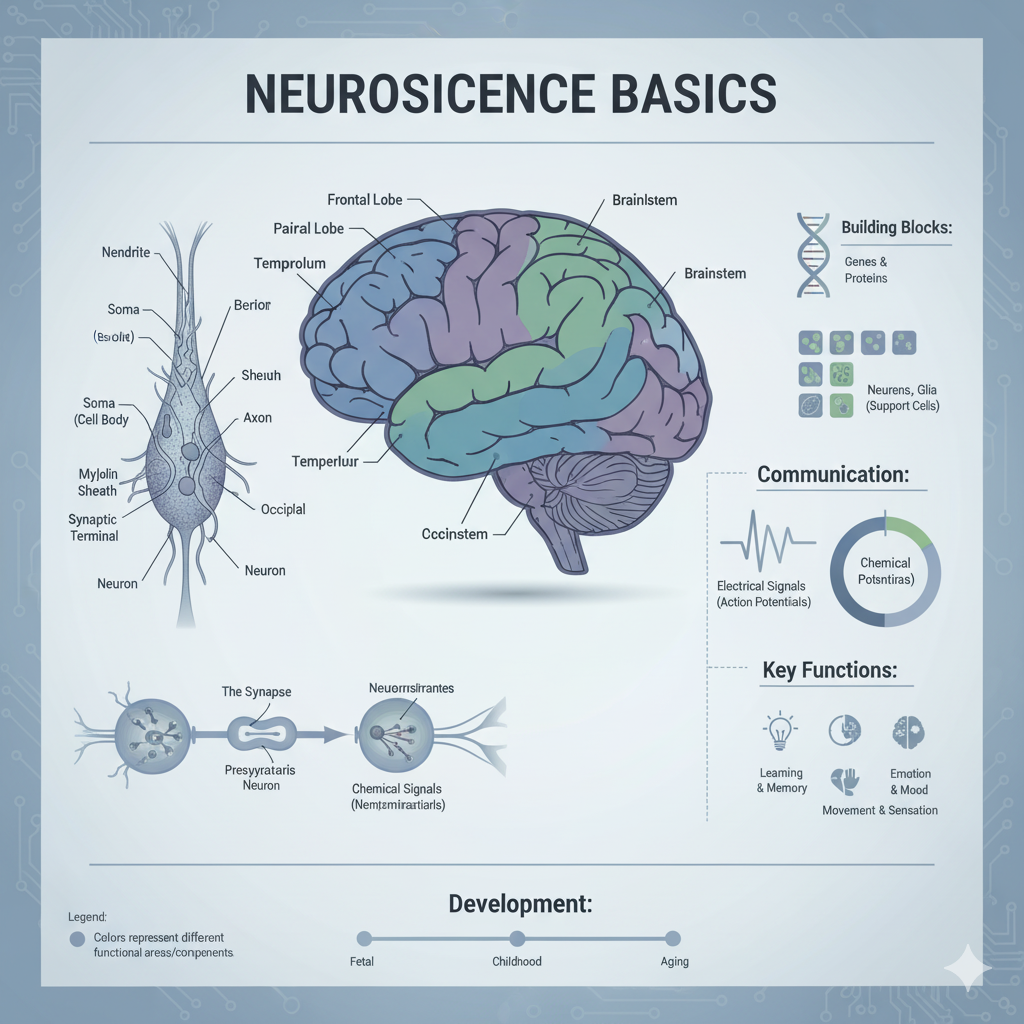
Key Concepts and Learning Guide
Welcome to Module 2. To effectively coach neurodivergent individuals, it is essential to have a basic understanding of the brain’s functions. We are not aiming to become neuroscientists, but to grasp the core concepts that influence how our clients think, learn, and process the world.
Think of the brain as a complex railway network. Different trains (neural signals) travel on different tracks (neural pathways) to reach their destinations. For a neurotypical person, the most common routes are well-established and used frequently. For a neurodivergent person, some tracks may be configured differently, a fast route enabling hyperfocus, a congested route affecting sensory processing, or a circuit that requires more energy to switch between tasks.
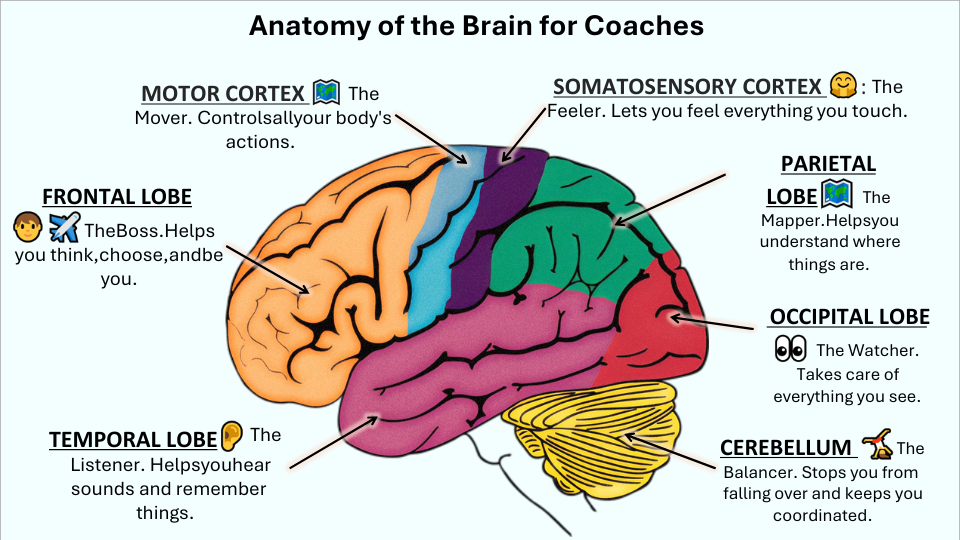
A visual guide to the human brain.
Key Brain Regions and Functions
The Prefrontal Cortex
The brain’s “control centre,” responsible for decision-making, planning, and emotional regulation. Differences here impact executive functioning. As Dr Russell Barkley notes: “ADHD is not a disorder of knowing what to do, but of doing what you know.”
The Amygdala and Sensory Processing
The amygdala regulates threat detection and emotional response. Heightened activation can contribute to sensory overwhelm or anxiety, reinforcing the importance of environmental considerations in the DDP.
Dopamine and Motivation
Dopamine impacts reward, motivation, and focus. ADHD is deeply tied to dopamine regulation, it is not about effort but about neurological reward architecture. This aligns with themes from Autism a Superpower.
Understanding these differences is not about identifying what is “wrong.” As the DDP framework emphasises, coaching requires recognising an individual’s neural map and designing strategies that align with their strengths and neurological profile.
Common Mistakes & Misconceptions
At Level 5, you must be able to identify, correct, and explain common errors in interpreting neuroscience. Below are the most frequent misconceptions, each reframed through a strengths-based perspective.
1. “The brain is a machine — diagnose the fault and fix it.”
The brain is a dynamic network, not a broken engine. Neurodivergence reflects difference, not damage.
2. “Executive function issues are laziness.”
Executive functioning is neurological, not moral. Motivation ≠ dopamine availability.
3. “All autistic/ADHD people are the same.”
There is more variation within neurotypes than between them.
4. “If someone can do it once, they can always do it.”
Performance is variable depending on load, environment, and dopamine.
5. “Emotional overwhelm is overreaction.”
Amygdala activation and sensory load are physiological, not behavioural.
6. “People grow out of ADHD or sensory issues.”
Neurodivergence is lifelong. Adults often mask, not outgrow.
7. “Routine and discipline fix everything.”
Rigid systems fail when they do not match neurological reward pathways.
8. “Struggling with multitasking means disorganisation.”
Multitasking is neurologically inefficient for almost everyone — especially ND individuals.
9. “Memory issues mean they aren’t trying.”
Working memory limitations are neurological, not intentional.
10. “Teach them to behave normally.”
Masking is harmful. Coaching supports authentic functioning, not assimilation.
Worked Example: Applying the Railway Analogy
Below is a fully modelled example of how a Level-5 neurodiversity coach analyses behaviour using neuroscience and the railway analogy.
Example Subject: A Programmer with ADHD Traits
Observed Traits: Exceptional problem-solving, rapid idea generation, difficulty initiating routine tasks, and inconsistent meeting attendance.
Railway Interpretation: Their “express line” connects creativity, logic, and rapid synthesis, enabling exceptional innovation. But their “local commuter line” (task initiation) is slow due to dopamine-dependent activation.
Coaching Strategy: – Use interest-driven task entry points – Implement body doubling – Replace long planning meetings with short asynchronous updates – Provide immediate, meaningful rewards for task initiation
This shows how the coach works with the individual’s neural configuration instead of forcing compliance with neurotypical patterns.
Applied Task: The Brain as a Tool
This task invites you to apply the neuroscience concepts from this lesson to real-world coaching thinking — using the “railway network” analogy to understand how unique neural pathways influence strengths and challenges.
Instructions for Learners:
- Choose a person, someone you know, a public figure, or a fictional character with neurodivergent traits.
- Apply the railway analogy:
- Identify one or two strengths or challenges.
- Explain how their neural “routes” might shape these traits.
- Apply these insights to a coaching scenario:
- How would a neurodiversity-informed coach support them?
- What strategies or adaptations would work with their brain, not against it?
- Write a short paragraph (150–250 words) summarising your interpretation.
Record your reflection in your learning journal and submit it to your tutor within 5 days.
Resources
This resource provides a clear and accessible introduction to the structure and function of the brain, supporting the key learning in this lesson.
- Brain Facts: A Primer on the Brain and Nervous System (PDF)
- The Railway Analogy: Understanding the Brain as a Dynamic Network (PDF)
The Railway Network Map Grid is also available as an online coaching resource.
Applied Task
Level 5Guidance for this level: Evaluate the potential outcomes of applying this idea in practice.
