
Lesson 4.1: Coaching Principles and Ethics
Coaching Principles and Ethics
This lesson introduces core coaching principles and ethical considerations, adapted for neurodivergent clients and neuro, affirming practice.
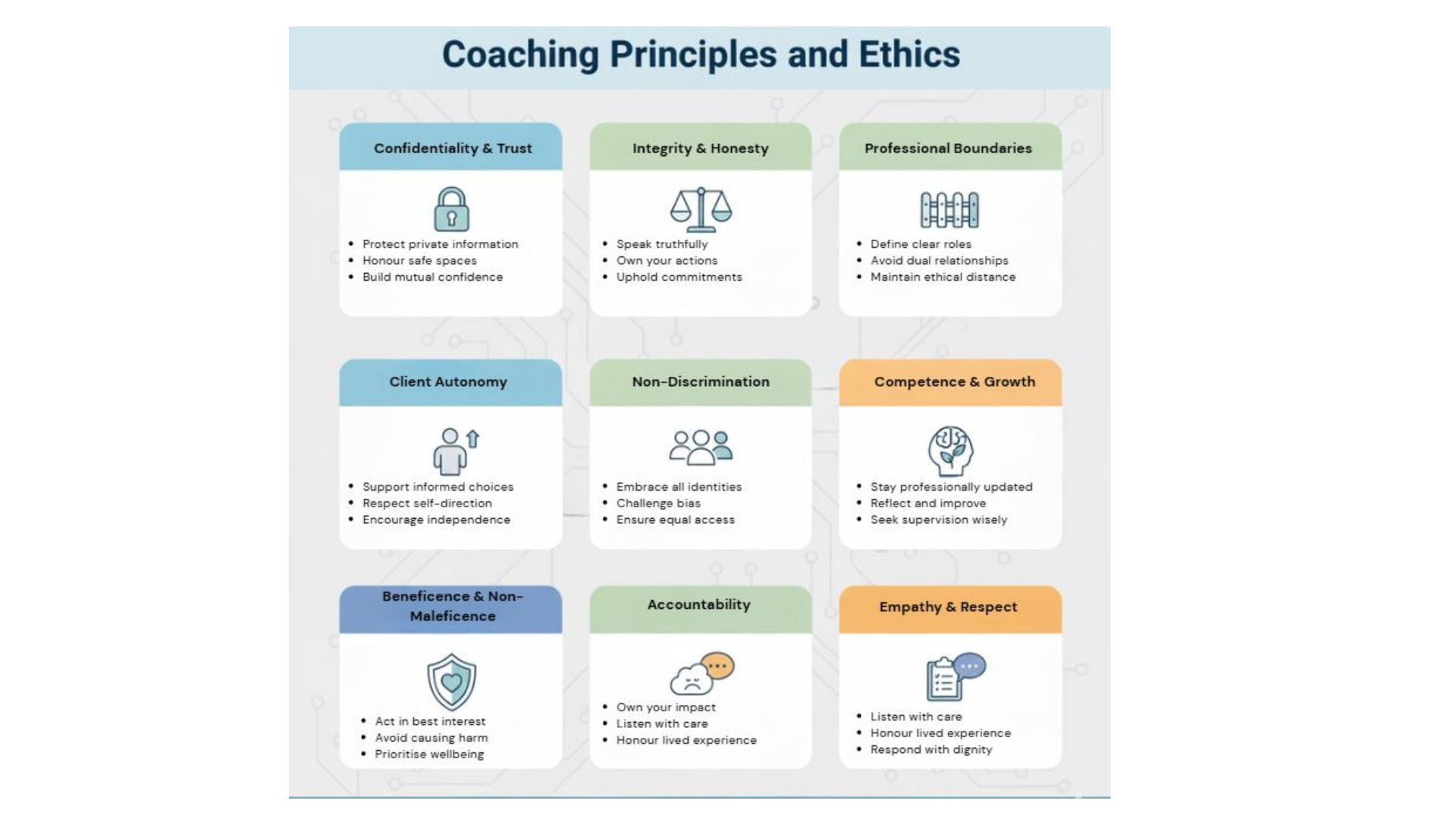
Key Concepts and Learning Guide
Welcome to Module 4. In this lesson, we draw on recognised executive coaching principles and apply them within a neuro, affirming framework. The familiar foundations, confidentiality, client autonomy, clear boundaries, and non, judgement, remain central, but their practical application looks different when we work respectfully with neurodivergent clients.
Executive coaching is often defined as unlocking a person’s potential to maximise their performance. A core principle is that the client holds many of the answers within themselves. Our role is not to fix or diagnose, but to ask purposeful questions that help them make meaning, identify options, and decide what they want to act on. This approach is particularly powerful for neurodivergent clients, whose thinking is often innovative but has been constrained by prescriptive advice, behaviour programmes, or deficit, led narratives.
In neuro, affirming practice, ethics and effectiveness sit together: the same commitments that protect a client, clear agreements, respect for difference, and honest communication, also create the conditions for deep learning and sustainable change.
Foundational Principles in Practice
Principle 1: Client Autonomy
The client is the expert in their own life. You are a facilitator, not a director. This is a vital ethical consideration, as many neurodivergent individuals have experienced a lifetime of being told what to do or being fixed. A neuro, affirming coach actively works to reverse this dynamic. The International Coaching Federation (ICF) describes coaching as a partnership in which the client is seen as creative, resourceful, and whole.
In Action:
Instead of: You need to learn how to make better eye contact.
Say: What kind of communication style helps you feel most comfortable and engaged?
Principle 2: Unconditional Positive Regard
Unconditional positive regard means accepting and supporting the client without judgement, regardless of what they say or do in sessions. For a Neurocoach, this involves approaching every behavioural challenge with curiosity and empathy, not criticism. Neurodiversity coach Dr Jo, Ann Harris notes that autistic clients do not need to be coached to become more like their neurotypical peers. Coaching aims to help them become more effective as themselves.
In Action:
Instead of: You are constantly distracted during our sessions.
Say: I have noticed your attention shifts at certain points. What is happening for you in those moments, and is there a way we can use that to your advantage?
Principle 3: The Power of Questions
One of your most effective tools is the clear, open question. Effective coaching questions help the client to notice patterns, explore options, and identify next steps that feel realistic and meaningful. Why questions can sometimes feel accusatory or invite shame; what and how questions tend to encourage reflection and problem, solving. As Sir John Whitmore observed, skilful questioning is central to discovery and learning.
In Action:
Instead of: Why are you always late?
Say: What are the steps involved in you getting ready in the morning, and how could we adjust those steps to make the routine easier?
Ethical Boundaries in Neuro, Affirming Coaching
A strong ethical framework is not an add, on to coaching; it is what makes the work safe, sustainable, and trustworthy. For neurodivergent clients, clear boundaries can be especially important after previous experiences of blurred roles, forced interventions, or unsafe services. Ethical boundaries are how you demonstrate respect for the client and protect both parties.
1. Coaching Agreements and Scope of Practice
The coaching agreement sets out what coaching is, what it is not, and how you will work together. It should be accessible and concrete, not written only in dense policy language.
- Describe clearly the focus of coaching, session length, frequency, and how to pause or end coaching.
- Clarify that coaching is not therapy, diagnosis, or crisis support, and say what you will do if those needs emerge.
- Offer the agreement in writing and talk it through, checking understanding in straightforward language.
2. Confidentiality and Information Sharing
Confidentiality builds trust. Neuro, affirming practice also recognises that many clients have had information shared about them without consent, often in ways that felt shaming or disempowering.
- Explain the limits of confidentiality, including safeguarding and legal duties, in plain language.
- Agree in advance how session notes are stored, for how long, and who can access them.
- Discuss any need to share information with employers, education settings, or family, and seek consent wherever possible.
3. Dual Relationships, Power, and Boundaries
The coaching relationship naturally carries a power difference. Neuro, affirming practice uses power ethically and transparently.
- Avoid roles that blur boundaries, such as becoming an employer, business partner, or close friend to a current client.
- Be clear about how you will handle contact outside sessions, for example emails, messaging, or social media.
- Use supervision or consultation if you feel pulled into fixing, rescuing, or over, functioning for a client.
4. Trauma, Aware, Non, Coercive Practice
Many neurodivergent people have experienced trauma linked to education, employment, health care, or social care. Ethical coaching avoids re, enacting these patterns.
- Use predictable structures for sessions and explain what will happen next to avoid surprises.
- Avoid shaming, controlling, or compliance, based language, even when a client is stuck.
- Offer choice wherever possible, and respect a client’s decision to pause a topic or take a break.
These principles and boundaries are threaded through the Dynamic Development Plan (DDP) framework. The DDP is co, created, not imposed. When you combine clear agreements, ethical boundaries, and strengths, based planning, you embody the philosophy of Autism a Superpower and support clients to grow on their own terms.
Applied Task: The Neuro, Affirming Coaching Synthesis
This task requires the integration of foundational coaching principles with the active management of ethical boundaries within a realistic coaching engagement.
Purpose:
To demonstrate professional proficiency in applying the Dynamic Development Plan framework while navigating the complexities of the coaching relationship, ensuring ethical integrity and client empowerment.
Task Requirements:
- Dialogue Construction: Create a comprehensive coaching dialogue, 12, 15 lines in length, featuring a neurodivergent client. The interaction must explicitly demonstrate a transition from strengths, based exploration, using autonomy and unconditional positive regard, to a moment where a professional boundary must be established or maintained, such as a shift into therapeutic scope, a request for unmediated advice, or a discussion regarding the limits of confidentiality.
- Critical Reflection: Write a critical reflection of 400, 500 words analysing the interaction. Your reflection should explain how the dialogue avoids deficit, led interventions and how your chosen boundary response upholds the neuro, affirming ethics established in Awakening the Workforce.
- Framework Integration: Link your strategies directly to the methodologies established in The Dynamic Development Plan and Autism a Superpower, ensuring the reflection demonstrates authentic professional reasoning and deep personal insight into neuro, inclusive coaching practice.
Record your synthesized scenario and reflection in your learning journal and be prepared to share this with your cohort during the next scheduled meeting. Submissions must be uploaded to the portal within 5 days of lesson completion.
Further Viewing: ICF Core Competencies in Action
To deepen your understanding of the coaching principles discussed in this lesson, the following short videos from the International Coaching Federation (ICF) demonstrate how core competencies look in practice. As you watch, consider how each competency might need to be adapted for neurodivergent clients.
- ICF Core Competency 1: Demonstrates Ethical Practice
- ICF Core Competency 2: Embodies a Coaching Mindset
- ICF Core Competency 3: Establishes and Maintains Agreements
- ICF Core Competency 4: Cultivates Trust and Safety
- ICF Core Competency 5: Maintains Presence
- ICF Core Competency 6: Listens Actively
- ICF Core Competency 7: Evokes Awareness
- ICF Core Competency 8: Facilitates Client Growth
Resources
Use these resources to consolidate your understanding of ethical, neuro, affirming coaching practice.
Reflective Task
Level 1Guidance for this level: Reflect simply on what you learned today.
