
Lesson 6.2: Resource Networks
Building Resource Networks
This lesson focuses on expanding your coaching approach to include the creation of supportive, human, centred resource networks that sustain long, term growth, well, being, and self, advocacy.
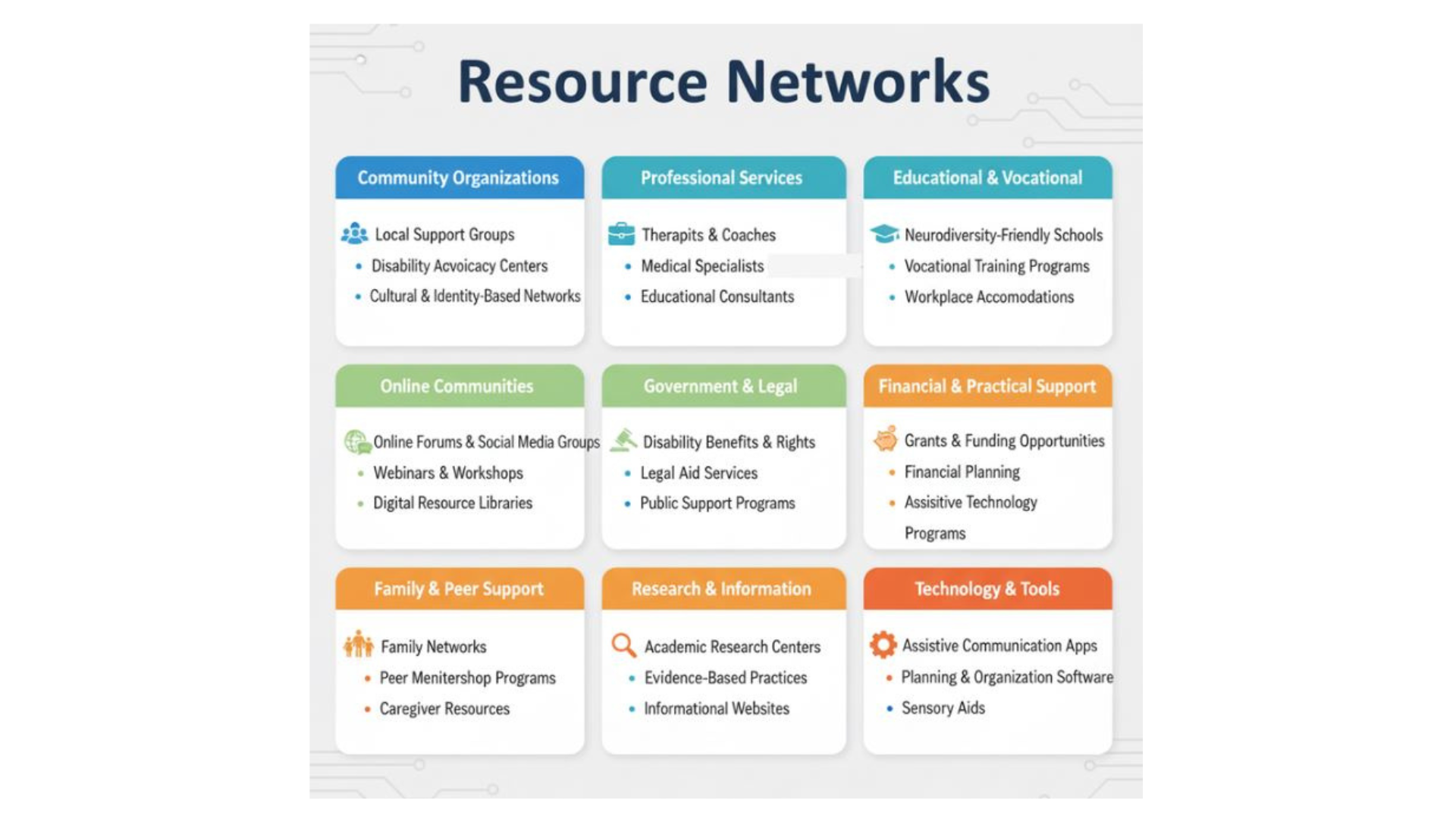
Key Concepts and Learning Guide
Welcome to Lesson 6.2. In the previous lesson, you explored how to create a toolkit of technology and aids to support a client’s unique needs. In this lesson, we widen the lens from tools to people. Your role as a Neurocoach is not to be the sole source of support, but to enable your client to build a wider ecosystem of relationships and resources that affirm and sustain their neurotype over time.
The Dynamic Development Plan (DDP) recognises that progress does not happen in isolation. A person’s development is shaped by their environment, communities, and access to opportunity. Thinking in terms of a supporting, ecosystem, rather than an individual trying to cope alone, mirrors contemporary approaches in neuro, inclusive education and mental health, where interdependence is seen as a strength rather than a weakness.
Concept Spotlight
You can think of resource networks as part of the client’s wider ecology, the people, services, and communities that surround them. A neuro, affirming coach helps the client shape that ecology so it works with, not against, their neurology.
Teaching Point: Building an Ecosystem of Support
Your most powerful contribution is often not advice, but your ability to support clients to identify, access, and navigate the right people and spaces. This includes helping them notice:
- Where support already exists but is under, used;
- Where unhelpful or draining relationships may need boundaries;
- Where new connections could unlock opportunity, safety, or belonging.
In DDP terms, this is about ensuring that goals and actions are held within a relational, context. A goal to return to work, for example, will be more sustainable if the client also has a mentor, a supportive manager, and a peer space where they can process experiences safely.
Types of Resource Networks
1. Professional Networks
For clients seeking career development or stability, professional networks can provide guidance, opportunity, and advocacy. These may include mentors, line managers, workplace allies, union reps, or professional bodies. The key is alignment: the network should recognise and respect the person’s neurodivergent profile, not demand masking.
Practical Action
Support a client to identify one or two potential mentors in their sector. Co, create an introductory, message that explains their interests and asks for a short, time, bound conversation. This structures outreach and reduces social, anxiety while modelling clear, respectful communication.
2. Social and Community Networks
Isolation is a significant risk factor for many neurodivergent people. Social and community networks can provide connection, shared interests, and identity, affirmation. These might include interest, based groups, online communities, volunteering spaces, or local initiatives that align with the person’s values and sensory needs.
Practical Action
A client who enjoys structured discussion but dislikes noisy environments may thrive in a small online book club or a moderated discussion group, rather than in large social events. Your role is to help them identify spaces where their natural style is an asset, not a barrier.
3. Peer and Lived, Experience Networks
Peer support and lived, experience communities can be transformative. Being in spaces where neurodivergent experiences are normalised and valued can reduce shame and internalised ableism. These networks also give clients access to practical, experience, based strategies that complement, rather than replace, coaching.
Practical Action
Explore with a client whether they would like to connect with autistic, ADHD, or wider neurodivergent peer, spaces. Discuss consent, boundaries, and emotional safety when entering new communities, so that connection feels empowering rather than overwhelming.
4. Therapeutic and Clinical Networks
Understanding professional boundaries is essential. Coaching is not therapy, diagnosis, or crisis intervention. At the same time, a coach can ethically signpost and prepare clients to access therapeutic or clinical support when needed, for example, counselling, occupational therapy, or psychiatric review.
Practical Action
Co, create a short appointment, script with a client who is anxious about speaking to their GP. Help them list key experiences, impacts on daily life, and what they are hoping for. This supports self, advocacy while respecting your scope of practice.
Safety and Safeguarding
If a client discloses risk of harm to themselves or others, your duty of care and organisational safeguarding policies override confidentiality. A clear, pre, agreed safety protocol should always sit alongside network, building work.
By helping clients map and strengthen their own network of support, you move beyond one, to, one, problem, solving into systemic, sustainable change. This aligns directly with the DDP’s vision: clients are not just working towards goals, they are reshaping the environments and relationships that surround those goals.
Applied / Reflective Task: Mapping and Strengthening Resource Networks
This task invites you to apply the principles of network, building to a real or case, study client. You will map their current support ecosystem, identify gaps or risks, and propose ethically grounded next steps.
Purpose
To practise viewing a client’s situation through a relational and systemic lens, and to design network, building actions that reinforce autonomy, safety, and neuro, affirming practice.
Task Details
- Choose a client, real or case, study. Use a pseudonym and remove any identifying details if you are drawing on real practice.
- Create a simple network map for this client, including at least three domains: Professional (e.g. manager, colleagues, mentor, union); Social, community (e.g. friends, clubs, online spaces); Wellbeing, clinical (e.g. GP, therapist, support organisations).
- Identify: Two existing supports that are helpful and why; One relationship or context that may be draining, risky, or misaligned with the client’s neuro, type; Two potential new connections that could strengthen their ecosystem of support.
- Write a 300, 400 word reflective commentary that explains how the client’s current network is supporting or constraining their goals; outlines 2, 3 neuro, affirming coaching actions you would take to help them build or adjust this network; and comments briefly on ethical considerations.
Example Extract
Viewing the situation as a network rather than an individual problem highlights how much their progress depends on reshaping relationships and environments, not on changing who they are.
Submission of Work
Please email your network map and commentary to your tutor or upload it through your learner dashboard, following your programme instructions.
Completed tasks should be submitted within 7 days of module completion.
Professional Resources
Utilise these templates to consolidate your understanding of building and reviewing support networks.
