
Lesson 5.2: Adaptive Techniques
Adaptive Coaching Techniques
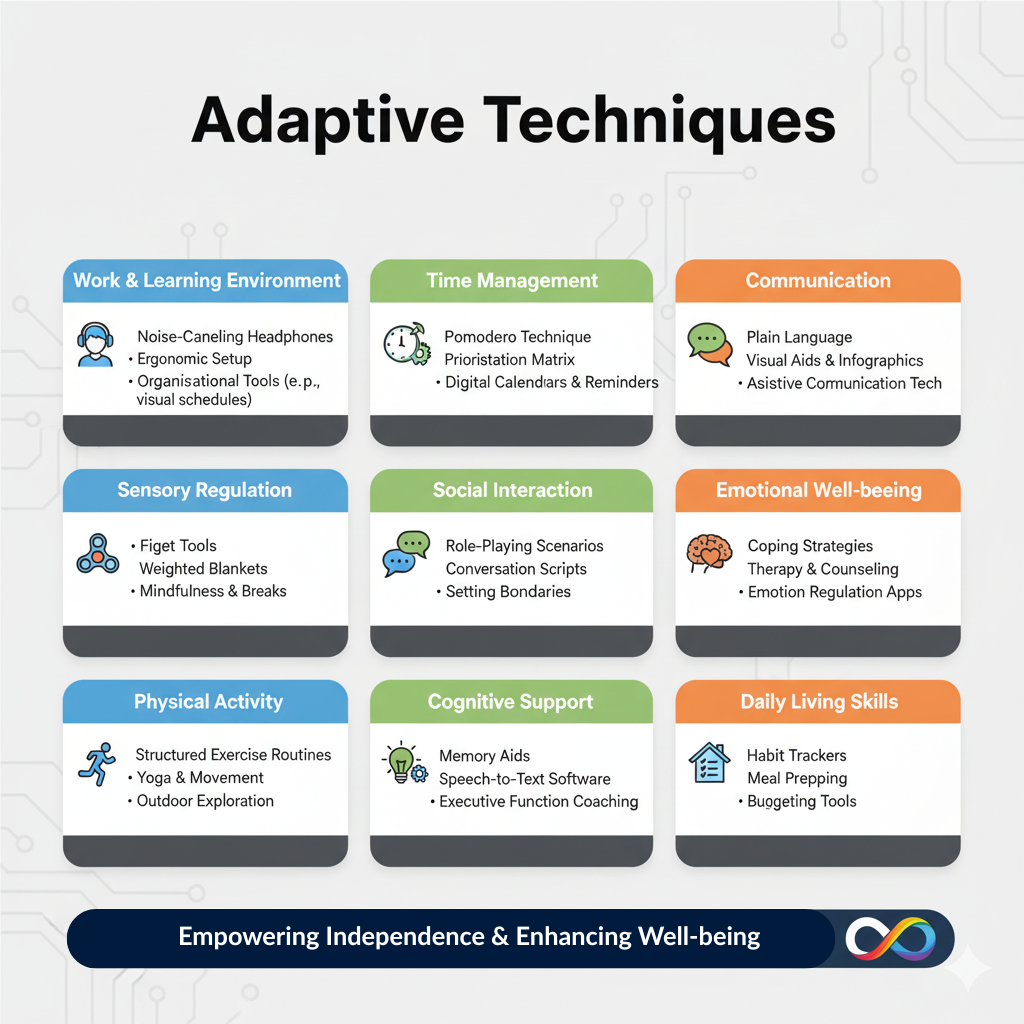
This lesson explores adaptive techniques that bring the Dynamic Development Plan (DDP) to life by supporting independence and self-advocacy through explicit teaching and scaffolded learning. These adaptive techniques should be recorded in the DDP and reviewed using the processes established in Lesson 5.1.
Key Concepts and Learning Guide
Welcome to Lesson 5.2. Having learned how to co-create a personalised plan, we now turn our attention to the specific adaptive techniques that bring that plan to life in practice. Your coaching toolkit is not a one-size-fits-all solution; it is a dynamic set of tools that must be adapted to each client’s sensory profile, processing style, and communication preferences. A key aim of this lesson is to learn how to explicitly teach a client to use these tools for themselves.
The concept of scaffolding from educational pedagogy is a powerful metaphor for our work. Just as a scaffold supports a building during construction, adaptive techniques provide a temporary structure that enables a client to achieve tasks that might otherwise be overwhelming. This is closely related to the idea of the “zone of optimal challenge”, where a person is supported to work just beyond what they can do alone, but not so far that the task becomes unmanageable. Once the client has practised and consolidated the skill, the scaffold can be gradually removed, enabling them to act with greater independence and confidence.
From a learning theory perspective, these approaches are consistent with models that emphasise reducing cognitive load, making information more accessible, and designing environments that work with a person’s strengths. In a neuro-affirming coaching context, this means we do not view supports such as visual aids, timers, or scripts as “crutches”, but as intelligent tools that honour how a person’s brain best processes the world.
Teaching Adaptive Strategies
1. Visual Support and Visual Aids
For clients who are visual learners, or who struggle with auditory processing, visual aids can be transformative. These tools reduce cognitive load by externalising information, making it easier to see patterns, break down tasks, and hold ideas in mind. In coaching, the key is not simply creating visual tools for the client, but explicitly teaching them how and when to use these tools themselves.
Example: A client struggles to follow a verbal to-do list. You co-create a visual to-do list on a whiteboard, digital planner, or notebook, using simple icons or colour-coding. You then walk the client through how to organise tasks into small steps, and how to use the list as a daily check-in, explaining that this visual structure supports their processing style rather than compensating for a deficit.
2. Using Technology as a Tool
Technology can serve as a powerful adaptive technique when used intentionally. The aim is not to make the client dependent on tools, but to identify technology that extends their strengths and supports executive functioning, time management, or organisation. Within the DDP framework, technology is framed as part of the person’s strengths toolkit, not as a sign of inadequacy.
Example: A client struggles with time management and frequently loses track of how long tasks take. You introduce a visual timer app that shows a colour-filled circle shrinking over time. Together, you practise using the timer for one or two daily tasks. You explain how this reduces the mental load of tracking time and allows them to focus on the task, reinforcing that the tool is a way of working with their brain, not against it.
3. Building Self-Advocacy Scripts
A key part of the DDP is empowering the client to be their own advocate. Self-advocacy scripts are short, rehearsed phrases or statements that help clients express their needs, preferences, and boundaries in everyday situations. They are especially valuable in contexts where the client may otherwise feel pressured to mask or remain silent. Rather than telling the client what to say, you co-create language that feels authentic to them.
Example: A client feels overwhelmed by loud meetings. Together, you develop a short script they can use, such as: “I process information better in a quieter space. Would it be possible to move to a smaller meeting room, or could I keep my camera off and use headphones?” You then rehearse this script in session, discuss how it might feel to use it, and identify safe opportunities to try it in real life.
4. Structuring the Environment and Routines
Sometimes the most effective adaptive technique is not a tool, but a change in environment or routine. Many neurodivergent clients experience sudden transitions, unpredictable demands, or sensory overload as the primary barrier, rather than the task itself. Supporting clients to structure their environment and routines is a way of honouring this reality.
Example: A client finds starting work in the morning overwhelming. Together, you design a predictable “start-up routine”: five minutes of planning, setting up a workspace with reduced sensory input, and doing one “warm-up” task before tackling anything complex. You record this routine as a simple visual sequence and agree a time of day when it will be used. Over time, the routine becomes internalised and the visual prompt can be faded.
These adaptive techniques are not about creating dependency; they are about building capacity. By explicitly teaching clients how to use visual supports, technology, self-advocacy scripts, and structured routines, you equip them with tools they can carry into future contexts. Within the Dynamic Development Plan, these methods turn the plan from a written document into a lived, practical framework that supports long-term autonomy and self-defined success.
Applied Task: Building Scaffolds for Independence
Apply the principles of scaffolding and adaptive coaching to design a personalised support strategy for a client. This task encourages you to translate theory into a concrete, neuro-affirming intervention that supports independence rather than dependence.
Purpose:
To practise creating a scaffolded coaching technique that enables independence, self-advocacy, and practical skill-building for a neurodivergent client, while making explicit links to learning and coaching theory.
Task:
- Select a client (real or case study) who experiences challenges with organisation, communication, transitions, or self-advocacy. Use a pseudonym if you are drawing on a real client.
-
Design a scaffolded intervention using one of the following (you may combine two if appropriate):
- Visual support (e.g., flowchart, checklist, visual schedule, or cue card)
- Technology tool (e.g., visual timer, task manager, reminder app, or notes app)
- Self-advocacy script (e.g., for meetings, appointments, or social interactions)
- Structured routine or environmental adjustment (e.g., start-up routine, sensory-friendly workspace)
-
Write a 200–300 word reflection explaining:
- How this scaffold supports the client’s independence, rather than doing the task for them.
- How you intend to fade this support over time as the client builds confidence or skill.
- How your approach connects to at least one theoretical idea (for example, scaffolding, cognitive load, explicit teaching, or strengths-based coaching).
- Conclude your reflection by stating how your intervention aligns with the strengths-based philosophy of the Dynamic Development Plan (DDP) and how it could be recorded within the client’s Individualised Coaching Plan.
Example:
Client: Finds transitions between tasks difficult and often “freezes” after completing one activity. Coach: Co-creates a simple visual step sequence using three coloured icons on a whiteboard to outline “Finish → Review → Start next task”. The coach explicitly teaches the client to talk through each step aloud while pointing to the icon. Scaffold: The visual sequence is used daily for two weeks, with the coach checking in on how it feels and adjusting the wording with the client. As the client begins to move between tasks more confidently, the sequence is copied into a small notebook that the client can keep privately, and the whiteboard version is gradually removed. Reflection focus: “The scaffold reduced uncertainty and decision-making load during transitions, allowing the client to internalise a predictable routine. This aligns with a strengths-based approach by recognising the client’s ability to follow a clear structure when it is made explicit and visual.”
Submit your written plan and reflection to your tutor within 7 days of completing this lesson. You may use any relevant templates from the DDP resource library to support your design.
Resources
This section contains supporting materials and templates to help you apply scaffolding and adaptive coaching methods in practice. Use these alongside your Individualised Coaching Plan to design, record, and review adaptive strategies with your clients.
- DDP Scaffolding Worksheet – A guided worksheet to help you plan, implement, and review scaffolded interventions linked to the Dynamic Development Plan.
- Visual Aids and Coaching Toolkit – Practical examples and templates for creating visual supports such as checklists, schedules, and cue cards.
- Self-Advocacy Script Template – A structured template for co-creating personalised self-advocacy scripts with clients in work, education, or community contexts.
Case Study Task
Level 4Guidance for this level: Analyse motivations and possible outcomes.
