
Lesson 5.1: Individualised Coaching Plans
Creating the Individualised Coaching Plan
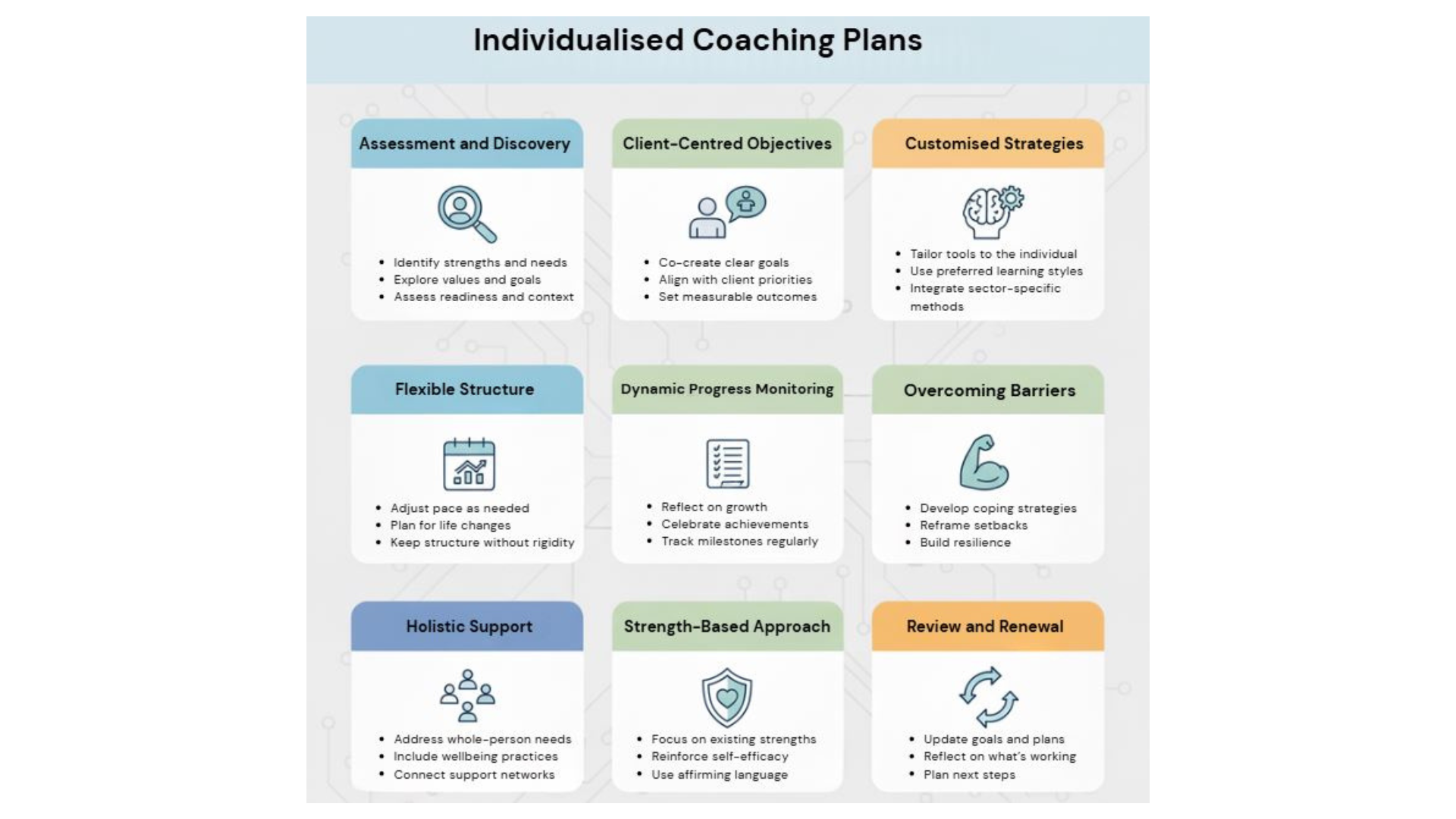
This lesson brings together all key principles to design a personalised, strengths-based coaching plan through the Dynamic Development Plan (DDP) framework.
Key Concepts and Learning Guide
Welcome to Module 5. In previous lessons you have explored communication, social interaction, coaching principles, ethics, and collaborative goal setting. This lesson asks you to integrate that learning into a single, coherent piece of practice: the Individualised Coaching Plan, built using the Dynamic Development Plan (DDP) framework.
The DDP is a structured yet flexible framework for turning insight into action. It is not a form to be filled in; it is a live, co-created tool that is constructed with the client, not for them. Each section should reflect shared understanding between coach and client: what matters to them, how they function best, and what change looks like in their own words. Without that shared understanding, the plan risks becoming just another document produced about them rather than with them.
At this stage in the programme you are expected to move beyond simply “using” a template. You are being asked to demonstrate that you can:
- Integrate communication strategies from earlier modules into the way you gather information for the plan.
- Apply strengths-based and neuro-affirming principles to the way challenges and goals are recorded.
- Design actions that are realistic, collaborative, and linked to the client’s own definition of success.
- Use the DDP as an ongoing reference point in coaching, not a one-off exercise.
In this way, the Individualised Coaching Plan becomes the central organising document that connects the whole coaching journey: past experience, present needs, and future aspirations.
Teaching the Co-Creation Process
1. Understanding the Client’s “Why”
Every section of the plan should be anchored in the client’s own reasons for engaging in coaching. Rather than starting with objectives chosen by an employer, family member, or service, begin with the client’s internal “why”.
For example, before discussing goals you might ask: “What does success look like for you over the next six months?” or “If coaching works well for you, what would feel different in your day-to-day life?” This keeps the plan grounded in intrinsic motivation instead of compliance.
In Action:
Rather than writing “Improve punctuality for work” as a starting point, you might record: “I want to feel less rushed and panicked in the mornings so that I can start work with a clear head.” The later action steps will then make sense in relation to this “why”.
2. From Challenges to Strengths
A core feature of the DDP is the deliberate reframing of difficulties into information about needs, preferences, and potential strengths. The aim is not to deny that barriers exist, but to describe them in a way that points towards solutions and genuine strengths.
For example, a client may describe “shutting down in noisy meetings”. Instead of recording this simply as a deficit, you might explore and record that they process information more effectively in written form, or in smaller groups. This links directly with the strengths-based message in Autism a Superpower, where traits previously framed as limitations are re-understood as differences that require the right context and support.
In Action:
Challenge: “I cannot keep up when people talk fast.”
Strength reframed: “I notice detail and think more clearly when I can read information or have time to process it.”
This reframe will later inform how goals and reasonable adjustments are written into the plan.
3. Co-Creating the Actions
Actions are the point where many plans become overly directive. In a neuro-affirming DDP, actions are designed with the client and written in language that they recognise as their own. Your role is to facilitate thinking, not to impose solutions.
Once a goal has been agreed, you might ask questions such as: “What feels like a realistic first step?” or “What kind of support would make this step easier?” This protects client autonomy and increases the likelihood that actions will be carried out.
In Action:
Instead of: “You need to attend every team meeting and speak at least once,” the action might read: “I will trial attending alternate team meetings and prepare one point in writing beforehand, which I can read out or share in the chat.”
4. Reviewing and Updating the Plan
An Individualised Coaching Plan is only effective if it is revisited. Review points should be built into the DDP from the start, not added as an afterthought. This reinforces the idea that the plan is a living document that can evolve as insight, confidence, and circumstances change.
Review conversations should explore what has been learned, not simply whether an action has been completed. This includes noticing where actions were unrealistic, where new strengths have emerged, or where external barriers (rather than personal effort) limited progress.
In Action:
A review section might include prompts such as: “What did we discover about what works for you?”, “What needs to change in the plan?”, and “What would you like to carry forward or remove?” This keeps the plan aligned with the client’s evolving experience.
When used in this way, the Dynamic Development Plan (DDP) becomes more than a record. It functions as a structured conversation, a shared reference point, and a visible representation of the client’s agency, strengths, and preferred ways of working.
Applied Task: Building the Individualised Coaching Plan (DDP in Practice)
Apply the Dynamic Development Plan (DDP) framework to co-create a personalised coaching plan for a client, focusing on collaboration, ownership, and strengths-based progression.
Purpose:
To practise developing a co-created plan that reflects the client’s authentic needs, motivations, and strengths within a neuro-affirming framework, and to demonstrate that you can integrate communication, goal setting, and ethical practice into one coherent piece of work.
Task:
- Select a case study or real client example (use a pseudonym if necessary). Briefly describe the context in no more than three sentences.
- Using the DDP template, complete the following three sections collaboratively with your client:
- Understanding the Client’s “Why” – Record what success looks like in their own words, including at least one emotional or sensory outcome (for example, “I want to feel…” as well as “I want to achieve…”).
- From Challenges to Strengths – Identify at least two challenges and reframe each as information about needs or potential strengths. Make sure the language is non-shaming and future-focused.
- Co-Creating Actions – Agree one short-term action (within four weeks) and one longer-term direction. Each action should clearly link back to the client’s “why” and reflect their preferred way of working.
- Note how communication techniques from earlier modules supported the process (for example, use of clear questions, double empathy, or checking understanding). Include at least two examples in your notes.
- Write a 250–300 word reflection that:
- Explains how the DDP work demonstrated a strengths-based, neuro-affirming approach.
- Comments on how co-creating the plan affected the client’s sense of ownership and engagement.
- Identifies one aspect you would refine next time you use the DDP.
Example:
Client: Finds meetings difficult due to auditory overload, and often leaves feeling “foggy” and exhausted.
Client’s “Why”:
“I want to feel confident contributing without being overwhelmed, and I want to leave meetings with a clear idea of what I am doing next.”
From Challenges to Strengths:
Challenge: “I lose track when everyone talks at once.”
Strength reframed: “I think more clearly when I can read information and take a few moments to process it before responding.”
Co-Created Actions:
Short-term: For the next two meetings, the coach and client will prepare a brief written summary of key points and questions in advance. The client will choose one point to focus on contributing.
Longer-term: The client will request written follow-up notes from the team lead, or agree that they will summarise their understanding by email afterwards.
Review Plan:
After two weeks, coach and client will review what has changed in terms of overwhelm and clarity, and decide whether to keep, adapt, or replace these actions.
Submit your completed DDP sections and reflection to your tutor within 7 days of completing this lesson. Use the official DDP template provided in the resources below.
Resources
This section contains the DDP template and supporting materials for developing your Individualised Coaching Plan.
Applied Task
Level 5Guidance for this level: Evaluate the potential outcomes of applying this idea in practice.
