
Lesson 3.2: Social Skills Development
Social Skills Development
This lesson provides tools to help neurodivergent adults enhance their social interactions in a way that aligns with their natural communication style.
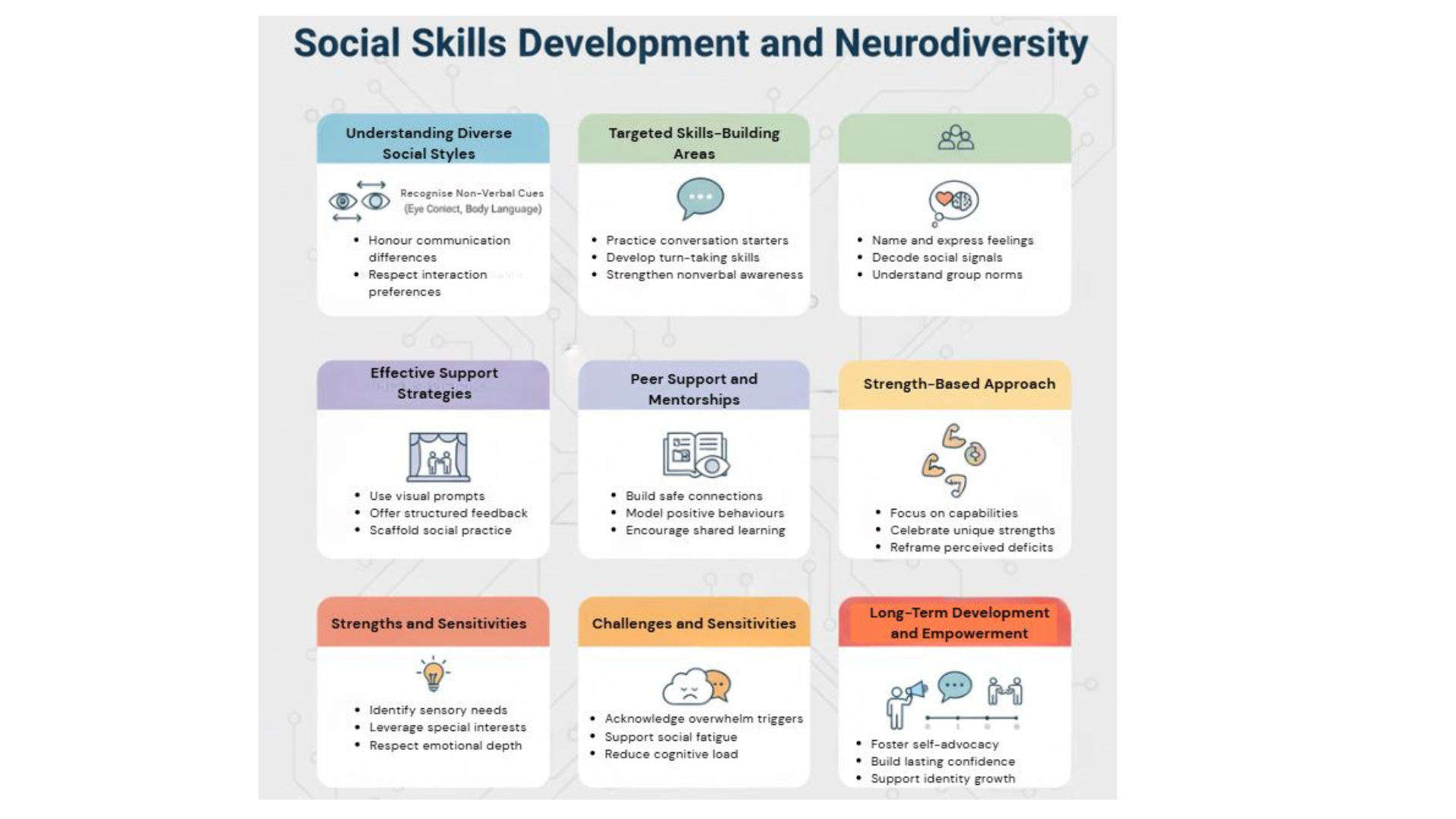
Key Concepts and Learning Guide
Building on the communication principles from Lesson 3.1, this lesson explores social interaction as a dynamic, relational process. Social skills development within a neuro-affirming framework does not aim to teach conformity, but rather to strengthen a person’s sense of agency, safety, and presence in social environments.
Social success is not measured by performance against neurotypical norms. Instead, we focus on contextual effectiveness, autonomy and authenticity. This means developing strategies that allow neurodivergent individuals to engage socially in ways that feel sustainable, safe and aligned with their identity.
Reframing Social Skills
Instead of ‘Appropriate’ vs. ‘Inappropriate’
Reframe as ‘effective’ vs. ‘ineffective’ in relation to context, environment, and personal capacity. This removes moral judgement and emphasises adaptability and choice.
In Action:
A client who communicates in detail and depth may struggle in fast-paced conversations, yet thrive in structured, interest-based groups. Your task is to help them recognise where their social strengths fit naturally and how to navigate environments that do not accommodate them.
Focus on Self-Advocacy
Authentic participation begins with the ability to articulate one’s needs without shame. Self-advocacy is essential for reducing masking, preventing burnout, and promoting psychological safety.
In Action:
Coaching a client to say, “I process information best when the questions are clear and direct; could you repeat that in a simpler way?” supports agency and reduces communication stress.
Understanding Neurodivergent Social Patterns
At this level, learners should be able to distinguish between “skill deficits” and environment, person mismatches. Many social difficulties arise not from a lack of social ability, but from:
- unpredictable or ambiguous social expectations
- sensory overwhelm (lighting, noise, proximity)
- processing delays that others mistake for disinterest
- communication double standards (e.g. expecting eye contact)
- historical experiences of rejection or misunderstanding
This reframing is central to the Dynamic Development Plan (DDP), which recognises that social capacity is highly context-dependent. Coaching focuses on equipping clients to:
- identify contexts where they naturally thrive
- reduce the cognitive load of social interaction
- set boundaries confidently
- build relational skills without compromising identity
These principles echo the strengths-based framing in Autism a Superpower and the leadership models explored in Awakening the Workforce, which emphasise psychological safety, clarity and inclusion as the foundations of social and organisational success.
Resources
The following resources support your learning by exploring neurodivergent communication, authentic social interaction, and self-advocacy. They provide both theoretical depth and practical tools suitable for Level 5 professional practice.
-
Neurolearn Resource: Understanding Neurodivergent Social Interaction Patterns (PDF)
A strengths-based overview of neurodivergent social styles, including sensory load, social energy budgeting, and contextual social effectiveness.
-
ASAN: Plain Language Guide to Social Interaction and Support
An autistic-led guide offering practical and ethical advice on communication and social understanding.
-
Ethical Frameworks: ASAN Principles and the DDP Comparison (PDF)
A synthesised comparison of ethical standards and practical strategic applications within the DDP.
-
Self-Advocacy Sentence Starters for Social Situations (PDF)
A practical resource offering scripts and phrases to support confident and authentic expression.
Applied Task: New Social Script
This task challenges you to design a realistic, neuro-affirming social strategy that supports autonomy, reduces masking and strengthens confidence in real-world social environments.
Instructions for Learners:
- Choose a challenging social situation such as:
- networking or small talk events
- team-based decision-making settings
- interactions with authority figures
- emotionally charged conversations
- Identify barriers from a neurodivergent perspective:
- sensory load
- processing delays under pressure
- conflicting social expectations
- previous negative experiences
- Create an authentic social script:
- include phrases that support clarity and self-advocacy
- include boundary-setting statements
- ensure your script avoids masking or forced conformity
- Write a short reflection (300, 400 words) explaining:
- why your script is neuro-affirming
- how it reduces cognitive load
- how it empowers autonomy in the situation
- how it builds on principles from Lesson 3.1
Record your script and reflection in your learning journal and submit to your tutor within 5 days of completing the lesson.
Reflective Task
Level 1Guidance for this level: Reflect simply on what you learned today.
