
Lesson 3.1: Effective Communication Techniques
Effective Communication Techniques
This lesson teaches strategies for clear and empathetic communication with neurodivergent individuals, focusing on building trust and understanding.
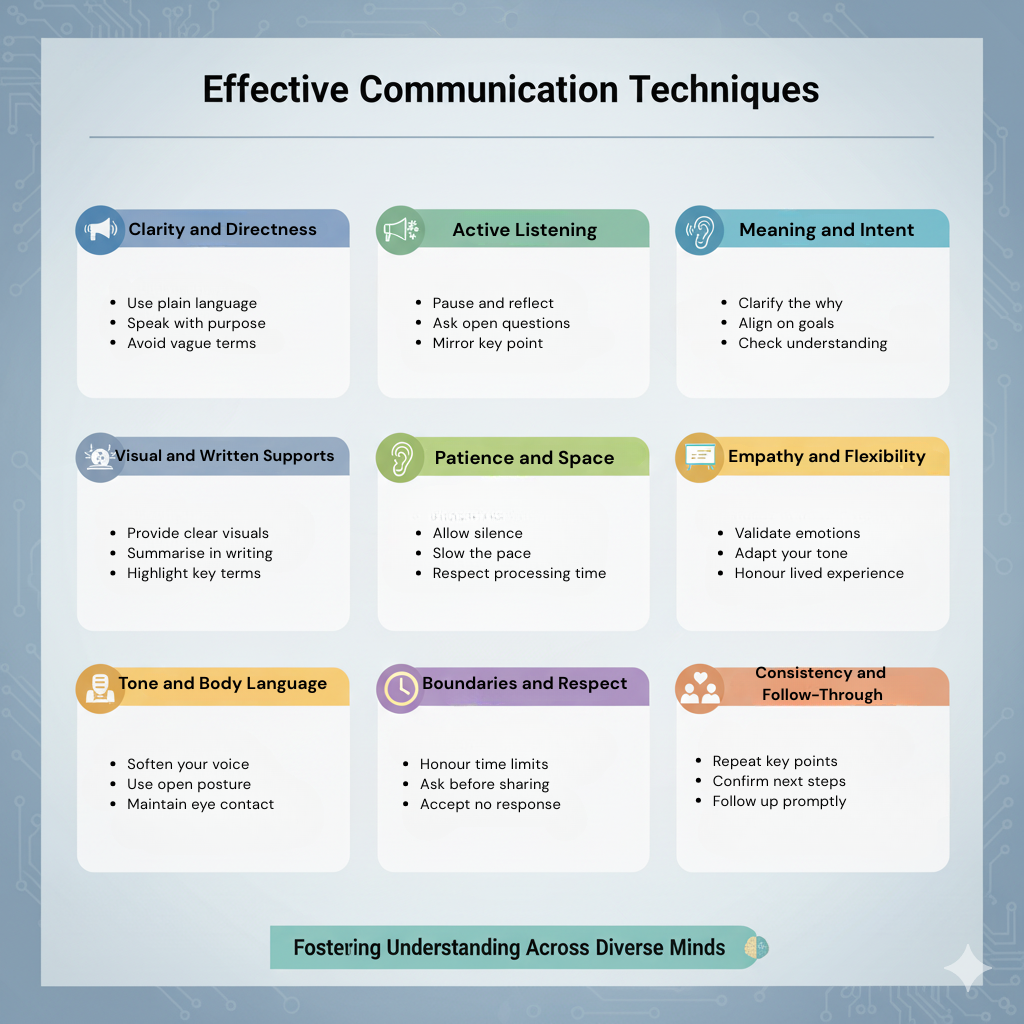
Key Concepts and Learning Guide
Welcome to Module 3, where we begin to turn foundational knowledge into practical application. The bedrock of any successful coaching relationship is communication. For a Neurocoach, this requires moving beyond standard communication models to truly connect with a client who may process information, and express themselves, in a completely different way.
Effective communication is not just about what you say, but how you listen and interpret. This is particularly true in neurocoaching, where you must consider a person’s sensory profile, processing speed, and communication preferences. Your goal is to create a safe, judgement-free space where they feel truly heard and understood.
Core Principles of Neuro-Affirming Communication
Radical Clarity and Specificity
Avoid abstract language, metaphors, and sarcasm. Be direct and clear. This clarity reduces cognitive load and prevents misinterpretation.
In Action:
Instead of: “Let us brainstorm some ideas for your career.”
Say: “Let us list five specific jobs that match your skills and interests.”
The Double Empathy Problem
Coined by Dr Damian Milton, this theory suggests that communication breakdowns between neurodivergent and neurotypical people are a two-way street, stemming from a mutual lack of understanding.
In Action:
Instead of: “Why do you not make eye contact when I am speaking?”
Say: “I have noticed you seem more comfortable looking away when we talk. If that helps you focus, that is completely fine. Just tell me you are ready when you are.”
Active and Patient Listening
This means giving the client ample time to process their thoughts and formulate a response. Do not interrupt or finish their sentences. Pay attention to their non-verbal cues, which may differ from typical expectations.
In Action:
Instead of: “So, you are feeling… overwhelmed?”
Say: “Take your time. There is no rush. What are your thoughts on that?”
These principles are vital for successfully completing the Dynamic Development Plan (DDP) with a client. The DDP requires a deep and accurate understanding of a person’s strengths and challenges, and this information can only be gathered through genuinely effective communication.
In a professional setting, as noted in Awakening the Workforce, mastering these communication skills is a key leadership trait. By leading with clear and empathetic communication, you can help build an inclusive culture where neurodivergent talent can truly thrive.
Ethical and Professional Standards in Neuro-Affirming Communication
Ethical communication is a cornerstone of Level 6 professional practice. For Neurocoaches, this means moving beyond generalist coaching models and recognising the specific ethical duties that arise when working with neurodivergent clients. These duties relate to power, consent, communication equity, and respect for neurological difference. Neurodivergent clients may have distinct sensory, emotional, and processing needs that require the coach to adapt their communication style, not the client.
1. Informed Consent and Communication Transparency
In neurodiversity-affirming practice, informed consent is not a one-time agreement; it is a continuous process. You must ensure that the client understands why you are asking particular questions, what will happen with the information they share, and that they can say no at any point.
- Explain the purpose of each task or line of questioning in plain language.
- Invite the client to ask for clarification or to pause a topic at any time.
- Check understanding with concrete questions, for example, “Would you like me to explain that in another way?”
- Offer information in formats that match their preferences, such as written summaries, visuals, or spoken explanations.
- Revisit consent when exploring sensitive areas such as trauma, school experiences, or employment breakdowns.
2. Respecting Communication Preferences
Neurodivergent clients may prefer to communicate in ways that differ from typical expectations. Professional practice requires you to notice, validate, and work with these preferences.
- Accept reduced or no eye contact without drawing attention to it.
- Allow extended processing time before expecting a response.
- Offer alternative methods such as typing, drawing, or using notes.
- Avoid assuming meaning based only on tone or facial expression.
- Check perception by asking, “How did you understand what I just said?” rather than correcting their interpretation.
3. Trauma-Informed Communication
Many neurodivergent individuals have experienced trauma linked to education, employment, health services, or exclusion. Trauma-informed communication reduces the risk of re-traumatisation by prioritising safety, predictability, and choice.
- Explain what will happen next in a session so that there are no surprises.
- Offer choices rather than directives, for example, “Would you prefer to start with your week or with your goals?”
- Avoid raised voices, sarcasm, or ambiguous humour that may be misread as criticism.
- Use neutral, non-shaming language, especially when discussing past difficulties.
- Validate emotional responses without minimising them, for example, “Given what you went through, it makes sense that you feel this way.”
For further reading, see the trauma-informed resources provided by Beacon House: https://beaconhouse.org.uk/resources/
4. Avoiding Coercive or Compliance-Based Language
Coercive language, even when subtle, damages trust and reinforces power imbalances. Neuro-affirming communication avoids framing the client as the problem and instead focuses on collaboration and autonomy.
Examples of coercive or compliance-based phrases include:
- “You should be able to do this by now.”
- “If you try harder, you will manage.”
- “You need to behave professionally.”
- “Let us focus on the positive, not the negative.”
- “Just follow the plan.”
Instead, Level 6 practice uses collaborative, permission-based phrasing.
For example, instead of: “You need to finish this task for next week.”
Say: “Would completing part of this task before next week feel manageable? What support would help?”
5. Managing Miscommunication Ethically
At Level 6, miscommunication is understood as relational rather than an individual failure. The coach shares responsibility for clarity and repair.
- Take responsibility for checking that your message has been understood.
- Recognise that literal interpretation or delayed responses may reflect processing style rather than resistance.
- Explore misunderstandings without blame, for example, “I think we may have understood this differently.”
- Use the double empathy lens to reflect on both your perspective and the client’s perspective.
- Model repair rather than correction.
An ethical repair might sound like: “I think I may not have explained that clearly. How did you understand it? Let me try again in a different way.” This protects rapport, reduces shame, and demonstrates that communication is a shared responsibility rather than a test the client can fail.
Resources
This section contains links to downloadable resources, templates, and further reading materials.
Applied Task: Neuro-Affirming Communication in Practice
To apply the principles of radical clarity, double empathy, and patient listening to realistic coaching situations, showing how small language changes can transform communication outcomes.
Instructions for Learners:
- Review the three core principles from this lesson:
- Radical Clarity – Use precise, concrete language.
- Double Empathy – Acknowledge mutual understanding gaps and adapt with curiosity.
- Patient Listening – Give clients time to process and respond in their own way.
- Select one of the following coaching moments (or use your own experience):
- A client seems disengaged or non-responsive during a session.
- A client struggles to answer abstract or open-ended questions.
- You misinterpret a client’s tone or body language and want to repair the connection.
- Apply the principles:
- Rewrite two or more coaching prompts or statements you could use in that moment, demonstrating radical clarity and double empathy.
- Describe how you would adapt your listening approach to support the client’s communication needs.
- Reflect and record:
- In 150–250 words, explain why your adapted approach is more neuro-affirming.
- Include what you learned about adjusting your own communication habits.
Write your response in your learning journal and submit to your tutor within 5 days of completing the lesson.
Applied Task
Level 4Guidance for this level: Demonstrate how to adapt this idea to a realistic case.
