
Lesson 7.2: Role-Playing Exercises
Role-Playing Exercises
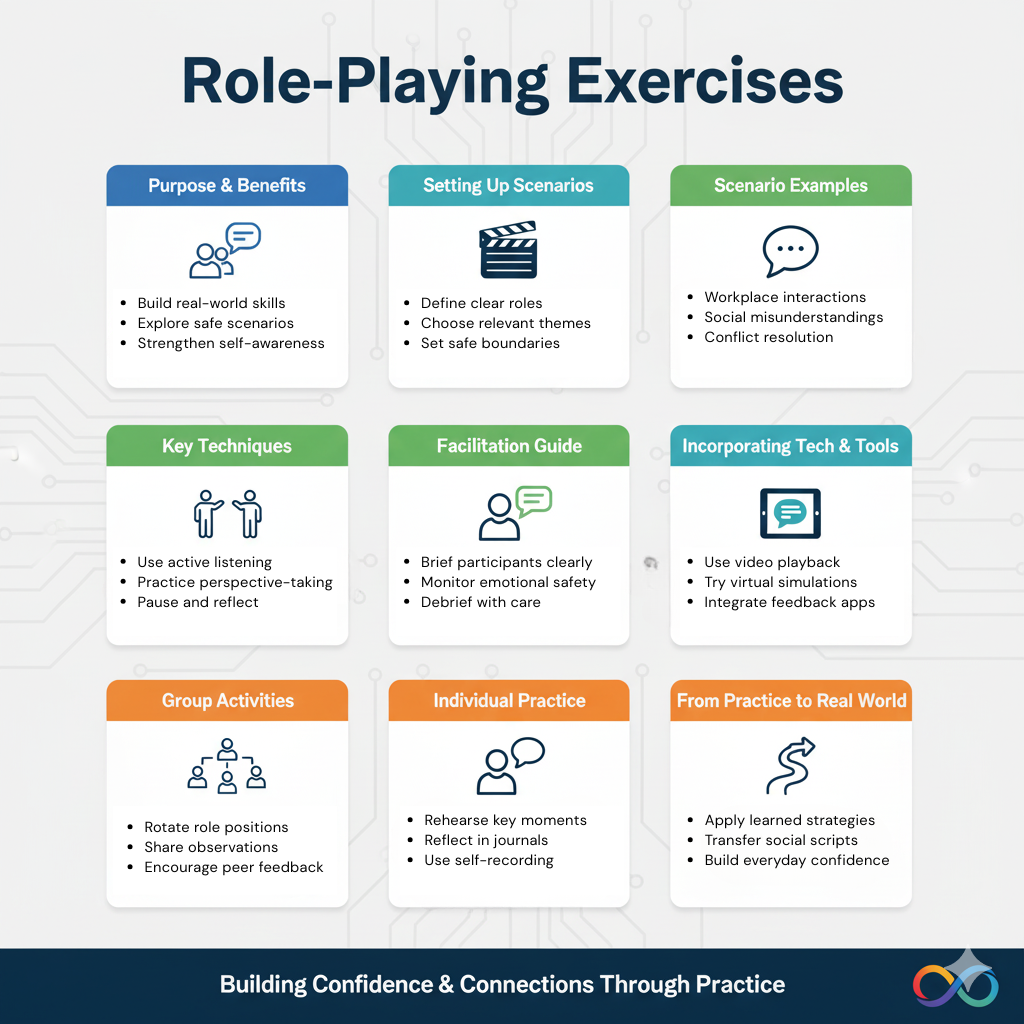
This lesson prepares you for a virtual role-playing workshop. The theory, structure, and safety of neuro-affirming role-play is embedded within the lesson narrative. The zoom session will allow for live coaching practice, observation, and feedback, followed by a post-workshop reflective task.
Theory and Preparation
Welcome to Lesson 7.2. In the previous lesson, you analysed case studies and explored how neuro-affirming coaching works in real-world contexts. This lesson is a virtual face-to-face workshop where you will move from analysis to direct practice. The session focuses on understanding the purpose, structure, and safety of role-play as a learning method.
This workshop is designed to help you integrate the core elements of this programme: neuro-affirming communication, co-creation, adaptive goal-setting, and ethical practice. Role-play offers a safe, structured environment in which to:
- Practise real-time coaching conversations.
- Experiment with different questioning and listening techniques.
- Receive constructive feedback from peers and tutors.
- Develop confidence and presence as a Neurocoach.
The emphasis is on learning, not performance. Mistakes are expected, and they are treated as valuable sources of insight rather than evidence of failure.
Psychological Safety, Consent, and Participation
Because many learners and clients are neurodivergent, the workshop prioritises psychological safety and consent. You will be invited to agree shared boundaries and to choose how you participate throughout the role-play sesssion.
Key safety principles include:
- Clear, shared agreements about language, pace, and topics.
- Permission to opt out of any activity without having to explain why.
- Simple, agreed signals for pausing or stopping an exercise.
- Respect for different processing speeds, communication styles, and sensory needs.
As a coach, you will also practise checking in with your partner, asking: “How are you experiencing this right now?” or “Would you like to slow down, pause, or reframe this question?” These practices model the consent-based, non-coercive communication expected in professional coaching.
Practising the Coaching Mindset
You are encouraged to revist the core coaching principles from earlier modules and applies them specifically to role-play. You are not practising a script; you are practising a mindset.
- Staying present and regulated, even during challenging moments.
- Using clear, non-leading questions (“what” and “how” more than “why”).
- Applying radical clarity and double empathy in real time.
- Honouring autonomy and avoiding directive or corrective language.
- Using the DDP as a live framework rather than a static document.
You will also explore how to manage your own internal responses — such as anxiety, the urge to “fix”, or concerns about “getting it right” — so that they do not overshadow the client’s experience.
Workshop Scenarios: Overview
The scenarios sent you will be used during the arole-play practice. You will explore them conceptually so that you understand the context and likely dynamics before entering role-play.
Scenario 1: The Entrepreneur with Executive Function Challenges
A dyspraxic and dyslexic entrepreneur with strong strategic vision struggles with time blindness, planning, and task completion. They experience shame and frustration when structures break down.
Key learning focus:
- Co-creating micro-goals and adaptive schedules.
- Using visual tools to support organisation.
- Reframing inconsistency as a predictable pattern that can be supported.
Scenario 2: The Creative with Communication Challenges
A highly creative designer with ADHD thrives when working alone but struggles in meetings due to auditory processing differences and slower verbal formulation.
Key learning focus:
- Supporting pre-prepared contributions.
- Using radical clarity to reduce ambiguity.
- Developing simple self-advocacy scripts.
Scenario 3: The Meticulous but Overwhelmed Professional
An autistic project manager known for accuracy and reliability is experiencing sensory overload and burnout related to masking and unrealistic expectations.
Key learning focus:
- Using unconditional positive regard.
- Exploring sensory needs without pathologising.
- Co-designing accommodations and boundaries.
By the end of your reading, you should feel clear about the aims of the workshop, the boundaries that will keep it safe, and the coaching mindset you will be practising, ready for tole-play coaching task.
Practical Coaching, Observation, and Feedback
The role-play session is a live coaching laboratory. You will work face-to-face with peers, rotating through the roles of coach, client, and observer. This structure allows you to experience the coaching relationship from multiple perspectives.
Structure of Each Role-Play Cycle
Each role-play cycle follows a clear structure so that you can focus on the quality of your interaction rather than worrying about what comes next.
- Live Coaching (4-6 minutes) – The coach leads a focused conversation using neuro-affirming techniques.
- Client Debrief (2 minutes) – The “client” shares what felt supportive or challenging.
- Observer Feedback (2 minutes) – Constructive, structured, strengths-first feedback.
This cycle repeats with rotated roles so that every participant experiences all three perspectives.
Roles and Responsibilities
- Coach: Practises active listening, questioning, and collaborative planning.
- Client: Brings the scenario to life authentically within boundaries.
- Observer: Provides constructive, strengths-based, DDP-informed feedback.
Tutors may also observe and offer additional guidance, particularly around ethical practice, communication patterns, and application of the DDP.
Intended Learning Outcomes
By the end of the coaching day, you should be able to:
- Demonstrate core neuro-affirming coaching skills in live practice.
- Adapt communication for different client needs.
- Use feedback effectively to improve your approach.
- Reflect on your strengths, challenges, and development goals.
The post-workshop reflective task below consolidates these outcomes.
Post-Workshop Reflective Task: Evaluating My Coaching Practice
After the coaching day, complete a written reflection of approximately 400–500 words. This is an opportunity to evaluate your practice using an academic lens and connect your experience to the programme’s theoretical principles.
Task:
- Select one role-play where you acted as coach. Briefly describe the scenario and focus.
-
Analyse how you used key neuro-affirming coaching principles:
- Radical clarity and double empathy.
- Client autonomy and non-directive questioning.
- Strengths-based reframing and co-created actions.
- Evaluate your coaching presence — including listening, pacing, body language, self-regulation.
- Reflect on feedback from the “client” and observer. Consider alignment or differences with your self-perception.
- Set at least two development goals linked to DDP values and the wider programme.
Your reflection should move beyond description into analysis and evaluation. Reference earlier modules where relevant.
Submit your 400–500 word reflection within 5 days of the workshop. Use the Role-Playing Reflection Template.
Resources
These resources support preparation, practice, feedback, and post-workshop reflection.
- Role-Playing Feedback Form – Observer template for structured strengths-based feedback.
- Peer Coaching Workshop Guide – Guidance on workshop roles, boundaries, structure, timings and peer coaching practice.
- Role-Playing Reflection Template – Framework for your 400–500 word academic reflection.
Reflective Task
Level 1Guidance for this level: Reflect simply on what you learned today.
