
Lesson 2.2: Psychological and Behavioral Aspects
Psychological & Behavioural Aspects
This lesson explores how emotions, sensory processing, executive function, and environment shape behaviour in neurodivergent individuals.
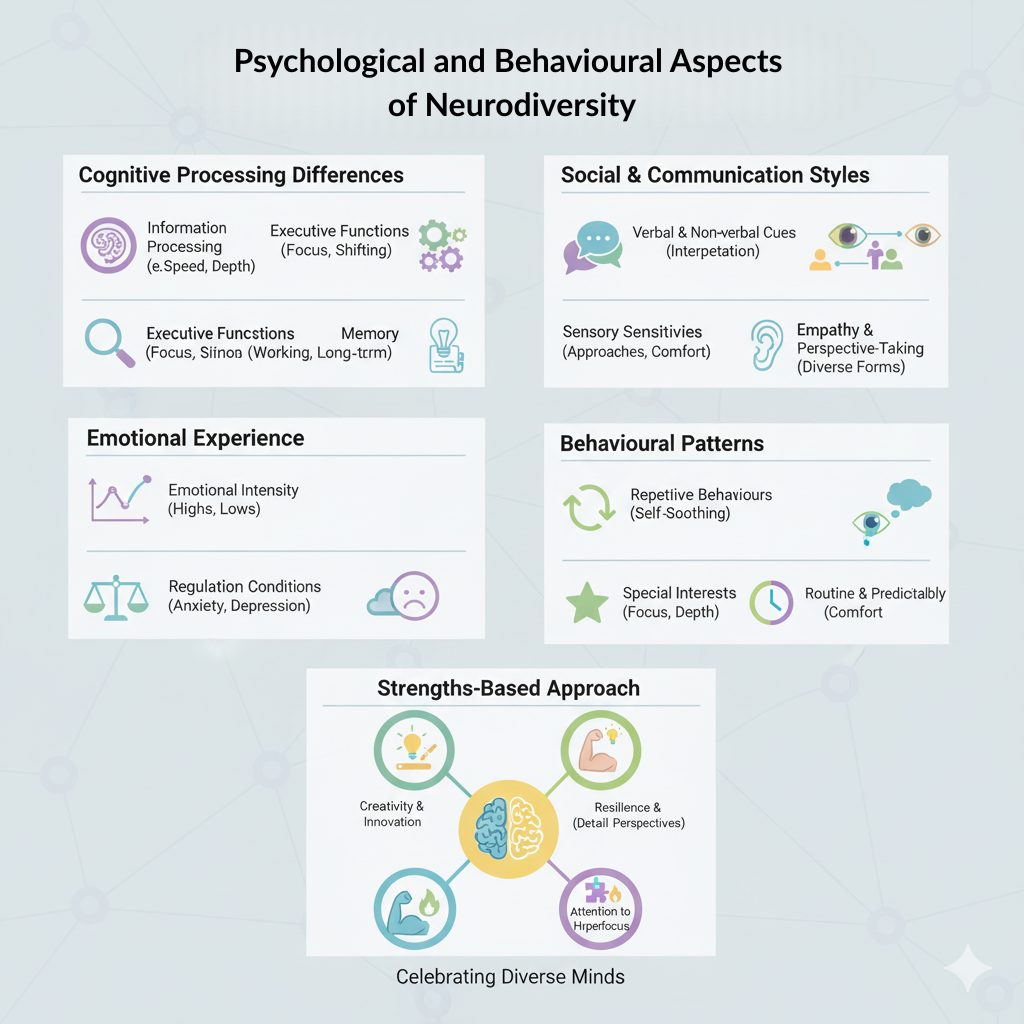
Key Concepts and Learning Guide
Understanding behaviour through a neurodiversity-affirming lens requires a shift from the old question, “What is wrong with this behaviour?” to the neuroaffirming question, “What is the brain trying to achieve?”
Behaviour is communication — and for neurodivergent individuals, it often reflects sensory load, emotional regulation, executive functioning demands, or the mismatch between neurological wiring and environmental expectations.
1. Behaviour as an Output of the Nervous System
Behaviour is shaped by:
- Sensory input
- Cognitive load
- Emotional state
- Environment
- Past experiences
- Unmet needs
This echoes the Dynamic Development Plan (DDP) principle: “Every behaviour has a purpose.”
2. Emotional Regulation & Behaviour
Neurodivergent emotional regulation can differ in:
- Intensity
- Duration
- Recovery time
- Trigger sensitivity
Important neurological elements include:
- Amygdala reactivity — heightened threat responses
- Prefrontal cortex switching — difficulty shifting from emotion to logic
- Autonomic responses — fight, flight, freeze, fawn cycles
Coaches support emotional regulation by recognising patterns, reducing overload, and promoting co-regulation and self-awareness.
3. Sensory Processing & Behaviour
Sensory differences strongly influence behaviour. Neurodivergent individuals may be:
Hypersensitive (over-responsive):
- Easily overwhelmed
- Prone to shutdown
- React strongly to noise, light, smell, texture
Hyposensitive (under-responsive):
- Movement seeking
- Pressure or sound seeking
- Drawn to high stimulation environments
Sensory overwhelm → behavioural escalation. A withdrawal, pacing, or exiting behaviour is often sensory survival, not avoidance.
4. Executive Function and Real-World Behaviour
Executive function influences:
- Task initiation
- Organisation
- Emotional control
- Cognitive flexibility
- Working memory
Misinterpreting these differences often leads to punitive responses rather than supportive adaptation.
5. Behaviour and Masking
Masking is a learned behavioural survival strategy involving suppression of true needs, stimming, communication preferences, or emotional responses.
Consequences of masking include:
- Burnout
- Anxiety and depression
- Identity confusion
- Exhaustion
Coaching aims to help clients unmask safely and authentically — not to reinforce compliance.
6. Strengths-Based Behavioural Reframe
Behaviour must be interpreted as:
- Signal, not symptom
- Adaptation, not defiance
- Communication, not malfunction
- Strengths expression, not weakness
| Behaviour | Old View | Strengths-Based View |
|---|---|---|
| Hyperfocus | Obsession | Deep task engagement & detail mastery |
| Stimming | Disruptive | Self-regulation & grounding |
| Interrupting | Rudeness | Fast processing, idea generation |
| Avoidance | Opposition | Sensory or cognitive overwhelm |
Common Mistakes & Misconceptions
“Behaviour is a choice.”
Behaviour reflects neurological state + environment, not willpower.
“If they can do it once, they can do it always.”
Performance varies with sensory load, emotional capacity, and executive function.
“Calm behaviour = regulated behaviour.”
Masking can appear calm while the person is in internal distress.
“Stimming is disruptive.”
Stimming supports self-regulation and reduces overwhelm.
“Avoidance is non-compliance.”
Avoidance often signals cognitive or sensory overload.
“Adults grow out of these behaviours.”
Neurodivergence is lifelong; coping strategies simply evolve.
“Emotional reactions are overreactions.”
Responses reflect nervous system intensity, not exaggeration.
“Direct communication = rudeness.”
Directness is often a cognitive processing preference.
“Inconsistency means unreliability.”
Variability is neurological, not motivational.
“A behaviour plan will fix the behaviour.”
Understanding the underlying need is what creates sustainable change.
Worked Example: The Socially Withdrawn Sixth-Form Student
Observed Behaviour: Student leaves group work suddenly, avoids collaboration, and prefers solitary tasks.
Interpretation: High social processing load, sensory strain from group noise, and executive function pressure contribute to withdrawal.
Strengths-Based Reframe: Independent thinking, deep focus, reflective learning.
Coaching Strategy: Provide pre-warning of group tasks, allow blended working (solo → pair → group), give processing time, and offer written participation instead of spontaneous discussion.
Outcome: Behaviour is understood as adaptive rather than oppositional, enabling engagement without forcing conformity.
Applied Task: Behavioural Reframe Analysis
This task invites you to analyse a real-world behaviour through a neurodiversity-affirming lens.
- Describe a behaviour you’ve observed.
- Identify neurocognitive or sensory factors that may influence it.
- Reframe it through a strengths-based lens.
- Suggest coaching or environmental adaptations.
- Write a 150–300 word reflection summarising your analysis.
Record your reflection in your journal and submit it to your tutor within 5 days.
Resources
Use these resources to deepen your understanding of behaviour, culture, and neuroinclusive practice. They support the ideas explored in this lesson and connect directly to the wider NeuroCoach and DDP frameworks.
- Chapter 6: Autism a Superpower – George Matheson
- Reframing Challenging Behaviour in our Schools
Applied Task
Level 3Guidance for this level: Apply the concept to a practical scenario relevant to your work.
