
EFYPH
19 November 2025 2025-11-19 19:36EFYPH
Elevating Futures For Young People
A Leader's Guide to the Dynamic Development Plan
First published 2025 by Elevated Futures Press
Copyright © 2025 Elevated Minds CIC
The right of Lane Anthony to be identified as the author of this work has been asserted in accordance with the Copyright, Designs and Patents Act 1988.
All rights reserved. No part of this publication may be reproduced, stored in a retrieval system, or transmitted, in any form or by any means, electronic, mechanical, photocopying, recording or otherwise, without the prior permission of the publisher.
Foreword
As the founder of Elevated Futures and the developer of the Dynamic Development Plan, it is my absolute honour to introduce this book. "Elevating Futures For Young People" is the definitive guide to implementing the philosophy that my entire career has been dedicated to.
Lane Anthony has masterfully distilled a lifetime of practice into a "working document" that is both practical and profound. This book is the blueprint for the "journey of change" you are about to undertake. It is the guide I wish I had when I began my mission. Read it, use it, and join us in transforming education from a system of deficit to one of dynamics.
Doreen Sinclair-McCollin, 2025
Table of Contents
Table of Contents
A Working Document for Your School's Journey of Change
Part 1: The Philosophy (The 'Why')
- Ch 1: The Case for Change: Moving from Deficit to Dynamic
- Ch 2: The Three Pillars of the DDP
- Ch 3: The Foundational Texts & Core Principles
Part 2: The Audit (The 'Where')
- Ch 4: Your 'Journey of Change' Starting Point
- Ch 5: Auditing Your Curriculum Through the DDP Lens
- Ch 6: Auditing Your Policies Through the DDP Lens
- Ch 7: Auditing Your Culture Through the DDP Lens
Part 3: The Implementation (The 'How')
- Ch 8: The Leader's Roadmap: A Step-by-Step Guide
- Ch 9: Transforming Your People (Roles, Training & Morale)
- Ch 10: Transforming Your Paperwork (The 'Living DDP' in Practice)
- Ch 11: Transforming Your Practice (The 'DDP Showcase' & 'Review Meeting')
Table of Contents
Part 4: The Golden Thread (The 'What')
- Ch 12: The DDP-Powered Curriculum Plan (Models & Frameworks)
- Ch 13: The DDP-Led Assessment Procedure (Models & Checklists)
- Ch 14: The DDP-Informed Behaviour Policy (Reframing Behaviour)
- Ch 15: The DDP & Safeguarding (Your Proactive Early Warning System)
- Ch 16: The DDP & All Other Policies (H&S, Equality, etc.)
Part 5: The Impact (The 'So What')
- Ch 17: Measuring Success: The DDP Payoff (Pupils, Staff, Parents)
- Ch 18: The Ofsted Framework: An 'Outstanding' Model
- Ch 19: Case Studies from the Elevated Futures Centre of Excellence
- Ch 20: Conclusion: Your School as a Centre of Excellence
Appendices
- A: The DDP Blank Template
- B: DDP Showcase Assessment Rubric
- C: DDP Review Meeting Agenda Template
- D: Staff Training & Coaching Model
Introduction
Introduction
As school leaders, we are driven by a single, unifying mission: to unlock the potential held within every child who walks through our doors. We dedicate our careers to this goal. Yet, how often do we find ourselves fighting the very systems designed to help us? How often does our paperwork bury us, our policies punish rather than support, and our assessments measure only gaps?
We have inherited a legacy of deficit. A system of Individual Education Plans (IEPs) that, by their very nature, are a list of what a child *cannot* do. We are told to be "data-driven," but this data so often only tells us a story of failure, of "below-average" metrics and widening gaps. This deficit model is exhausting for staff, disheartening for parents, and, most tragically, it is damaging for children. It teaches them from a young age that they are a problem to be fixed.
This book is the antidote. It is a practical guide to a different way.
It is the blueprint for embedding the Dynamic Development Plan (DDP), a philosophy and practice that fundamentally reframes our approach. The DDP is not just a replacement for the IEP; it is a replacement for the deficit mindset. It is a commitment to seeing every child through the lens of their unique strengths—their "superpowers"—and building an entire school culture on that foundation.
This is not theory. It is the proven model that powers Elevated Futures, our national Centre of Excellence. This book is a "working document" for your school's journey of change. It will challenge you, guide you, and provide a step-by-step framework for transforming your school from a place of deficit to one of dynamics.
Part 1: The Philosophy
Chapter 1: The Case for Change
Moving from Deficit to Dynamic
For decades, the system of support for pupils requiring additional help has been built on a "deficit model." This model, while well-intentioned, is fundamentally flawed. It is a top-down, expert-led process where a group of adults identify a child's "problems" and write a plan *for* them, which is then delivered *to* them.
Consider the language of this model. We talk of "learning difficulties," "behavioural problems," "disorders," and "gaps." The paperwork reflects this. The average IEP or support plan is a list of what a child struggles with, what they are "below average" in, and what they must "overcome." This process is static; the plan is often written in September, reviewed in July, and filed away. It is not a living document used in the classroom.
This deficit model creates a negative feedback loop for everyone involved:
- For the Pupil: "I am a list of problems. I am the person who can't. I am 'below' everyone else. School is a place where I am reminded of my failures."
- For the Staff: "My job is to fix this child. I am a problem-manager. I am fighting a losing battle to 'close a gap' that is defined by a static test."
- For the Parent: "Every meeting is a list of what my child did wrong or cannot do. I am in a constant state of advocacy, defensiveness, or despair."
This model is no longer fit for purpose. It does not build resilience, it does not foster self-advocacy, and it does not prepare children for a complex, modern world.
Part 1: The Philosophy
The Dynamic Alternative
The Dynamic Development Plan (DDP) is a fundamental paradigm shift. It is not a simple rebranding of the IEP; it is a total reconstruction of the support process. It shifts the entire centre of gravity from the *deficit* to the *strength*.
The DDP model argues that the *only* sustainable way to support a child's challenges is to build upon their strengths. The "superpower" (a passion, a talent, a way of thinking) is the *key* that unlocks the door to the challenges. Instead of trying to batter the door down, we find the key, and we teach the child how to use it for themselves.
This "strengths-based" model flips the entire feedback loop from negative to positive:
- For the Pupil: "I am a person with unique talents. I am 'good at' things. School is a place where I can use my 'superpower' to help me learn."
- For the Staff: "My job is to be a talent-spotter. I am a skills-coach. I get to connect my lesson to a child's passion and watch them succeed."
- For the Parent: "My meetings are a celebration of my child's progress. I am a respected partner in a team that truly *sees* my child."
This is the "Dynamic" in the DDP. It is not static; it is a living system of positive, formative feedback. It is not a list of problems; it is a celebration of progress. This is the journey of change this book will guide you on.
Part 1: The Philosophy
Working Document: Reflection Point
Before moving on, take a moment to reflect on your current school culture. This is the first step in your journey. Be honest.
- When you have a meeting about a child of concern, what is the first thing you discuss: their strengths or their challenges?
- Pull out one of your current IEPs or support plans. Take a highlighter. How much of it is written in positive, strengths-based language? How much is deficit-focused?
- What is the "feeling" of your parent consultation evenings? Are they a celebration of progress or a negotiation of problems?
- How many of your pupils could articulate their own learning targets to you?
Use the space below for notes:
Part 1: The Philosophy
Chapter 2: The Three Pillars of the DDP
You asked if the pillars in this book are the same as those in the foundational text, The Dynamic Development Plan: A Blueprint. The answer is yes. Those pillars are the unchanging bedrock of this entire philosophy. This book expands on them, showing you how to build your entire school upon them.
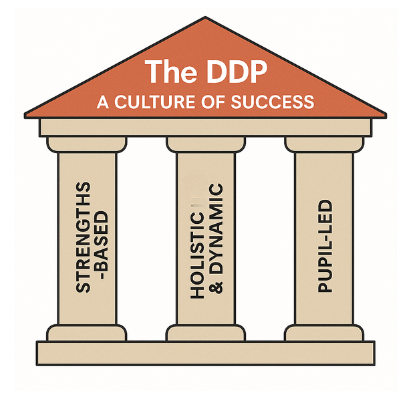
The DDP is not a set of instructions, but a way of thinking, held up by three core pillars. If you embed these pillars in your school's culture, every policy and practice will naturally begin to align.
Diagram: The Three Pillars
Part 1: The Philosophy
Pillar 1: Strengths-Based ("Finding the Superpower")
This is the most significant shift. The DDP's first question is never "What are the challenges?" It is "What are the strengths?"
We call these "Superpowers."
A "superpower" is not just a vague "he's good at drawing." It is a deep, intrinsic talent or passion that can be leveraged for learning. It is the leader's and teacher's job to become a "talent-spotter."
- A pupil with a "superpower" for Logic might struggle with expressive writing but will excel when asked to "code" a story with "if-then" statements.
- A pupil with a "superpower" for Empathy might struggle with data analysis but will excel when asked to analyse a historical event from a human perspective.
- A pupil with a "superpower" for Kinaesthetics (a need to move) might struggle to sit still but will excel in a maths lesson where they physically build the equations with blocks.
The "superpower" is not a reward; it is the gateway to the curriculum. We do not say, "If you finish your writing, you can do some drawing." We say, "Let's use your drawing talent to plan your story."
Part 1: The Philosophy
Pillar 2: Holistic & Dynamic ("The Living Document")
The DDP is not a static document that is filed away. It is a "Living Document" that is central to daily practice. This is built on two concepts:
Holistic
The DDP breaks down the artificial wall between "academic" and "pastoral" support. A child cannot access their fractions lesson if they are overwhelmed by anxiety. A child cannot manage their friendships if they lack the language to express themselves.
The DDP tracks academic, personal, social, and emotional goals as one. A therapeutic goal (e.g., from a SaLT or OT) is not on a separate report; it is *on the DDP* as a key goal that all staff can work towards. This creates a "common language" for all professionals.
Dynamic
The DDP is updated constantly. It is an "assessment *for* learning" tool. When a teacher spots a new talent or sees a pupil achieve a short-term goal in a lesson, they can update the DDP. This means the DDP reflects the child's *current* reality, not a snapshot from six months ago. It is a "living" plan for a growing, changing child.
Part 1: The Philosophy
Pillar 3: Pupil-Led ("Building Self-Advocacy")
This is the ultimate goal. The DDP is not done *to* a pupil; it is co-created *with* them. This is the key to building ownership and the single most important skill they will ever learn: self-advocacy.
From the moment of their "Strengths-Finding" baseline, the pupil is the expert in the room. We ask them: "What are you great at? What do you love? What do you find tricky? What do you want to achieve?"
By co-creating their own goals, pupils learn to understand *how* they learn. They learn to identify their own "superpowers" and, crucially, they learn how to ask for help.
A DDP-led pupil doesn't say "I'm bad at maths." They learn to say: "I find it hard to focus when there are lots of numbers. Can I use my 'superpower' and build this with blocks first?"
This is the "payoff." We are not just creating better pupils; we are creating confident, resilient, self-aware young people who are ready for their post-16 transition and for life.
Part 1: The Philosophy
Working Document: Reflection Point
Consider the Three Pillars in your current setting.
- Strengths-Based: How many staff in your school could name the specific "superpower" of the most challenging child they teach? How do you currently use strengths in lesson planning?
- Holistic & Dynamic: How "live" are your current support plans? How often are they updated? How well do your therapeutic goals (from SaLT/OT) integrate into daily class teaching?
- Pupil-Led: What percentage of your pupils with support plans were physically *in the room* when the plan was created? How many could explain their own targets to you?
Use the space below for notes:
Part 1: The Philosophy
Chapter 3: The Foundational Texts
How This Book Connects
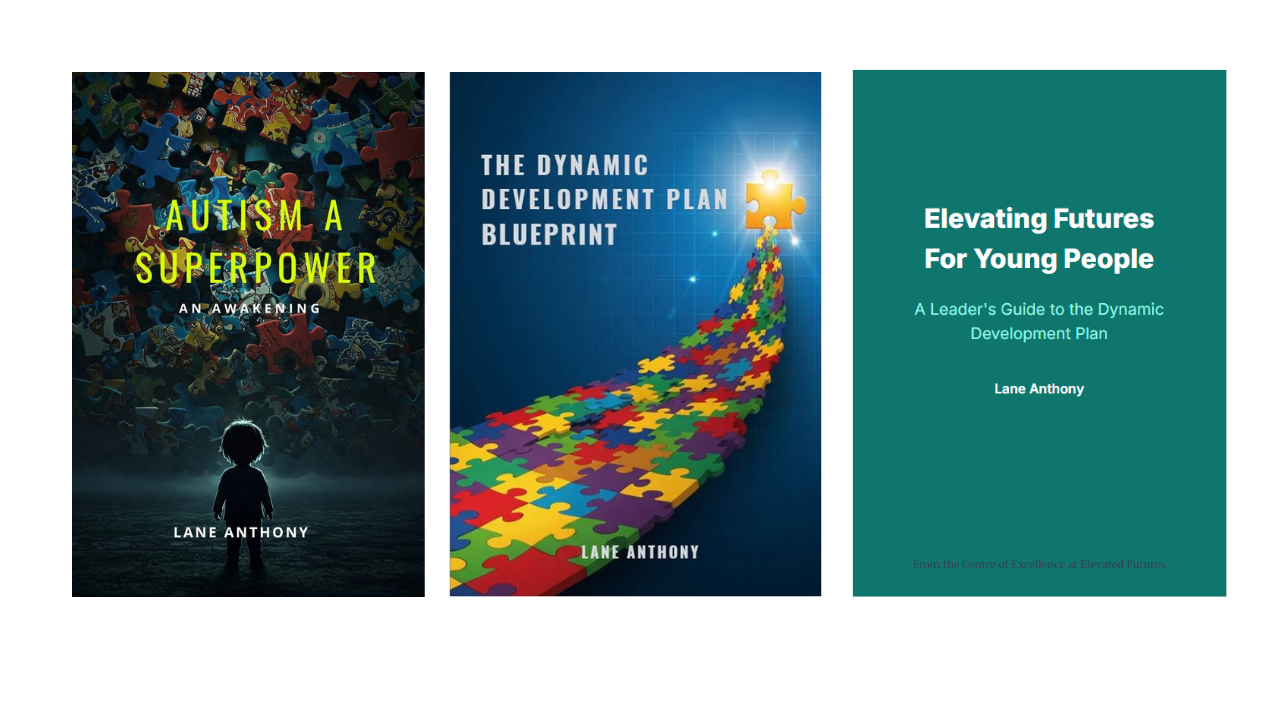
This book, "Elevating Futures For Young People," serves as the overarching implementation guide for leaders. It is the capstone of a philosophy built on two foundational texts, which you may already be familiar with. This guide shows how to take the *principles* from those books and turn them into whole-school *practice*.
Diagram: The DDP Literary Framework
Part 1: The Philosophy
1. The "Why":
Autism a Superpower: An Awakening
This is the heart and the origin story of the DDP philosophy. It lays the groundwork for the "strengths-based" pillar. It tells the personal and professional stories that led to the rejection of the deficit model. It is the "why" behind the "what."
This book is essential reading for all staff to understand the culture of empathy, respect, and "talent-spotting" you are building.
2. The "What":
The Dynamic Development Plan: A Strengths-based Blueprint
This is the foundational text that introduced the DDP as a practical replacement for the IEP. It provides the core templates, explanations, and pedagogy. It is the "what" that this book builds upon. It is the blueprint; this book is the construction manual.
3. The "How":
Elevating Futures For Young People (This Book)
This book is the final piece of the puzzle. It is written specifically for you, the school leader. It takes the "why" from Autism a Superpower and the "what" from the Blueprint and gives you the "how"—the strategic, step-by-step guide to embedding this philosophy in every policy, practice, and person in your school.
Part 2: The Audit
Part 2: The Audit
Where Are You Now?
You cannot plot a course for your destination until you know your starting position. This section of the book is your "Journey of Change" Audit. This is a working, practical tool.
The following chapters are designed to be completed *by you* and your leadership team. They provide checklists and reflection points to help you identify every policy, practice, and cultural habit in your school that is currently "deficit-focused."
This is the most critical and challenging part of the process. It requires radical honesty. But once you have completed it, you will have a clear, actionable list of "starting points for transformation" that will form the basis of your implementation plan in Part 3.
Part 2: The Audit
Chapter 4: Your 'Journey of Change' Starting Point
Phase 1: Auditing Your Language & Culture
The deepest-rooted part of a deficit model is not in your paperwork; it is in your language. The words we use shape our reality and the reality of our pupils. This first audit is about listening.
Working Document: Language Audit
For one week, listen in your staffroom, in meetings, and in corridors. Place a tick in the "Deficit" or "Dynamic" column. Be honest.
| Phrase / Concept | Deficit (Heard often) | Dynamic (Heard often) |
|---|---|---|
| "He's a 'behaviour problem'" | ||
| "She has a 'processing delay'" | ||
| "His superpower is his logic" | ||
| "What are his triggers?" | ||
| "What are his strengths?" | ||
| "We need to 'manage' his behaviour" | ||
| "We need to 'teach' him self-regulation" |
Use the space below for notes:
Part 2: The Audit
Phase 2: Auditing Your Paperwork
Gather your key documents. For each one, assess it on a scale of 1 (Purely Deficit) to 5 (Fully Dynamic & Strengths-Based).
Working Document: Document Audit
| Document / Policy | Current Score (1-5) | Notes: (Why this score?) |
|---|---|---|
| IEP / Support Plan Template | ||
| Pupil Assessment Policy | ||
| Behaviour Policy | ||
| Parent Report Template | ||
| Curriculum Plan | ||
| Safeguarding Policy |
Part 2: The Audit
Phase 3: Auditing Your Practice
Finally, assess the "lived reality" of your school. This is what actually happens, regardless of what the policies say.
Working Document: Practice Audit
| Practice | Deficit (Our current reality) | Dynamic (Our current reality) |
|---|---|---|
| Parent Consultations are... | Staff-led, data-focused, about problems. | Pupil-led, holistic, about progress. |
| Pupils with support plans are... | Withdrawn for interventions. | Supported in class, using their strengths. |
| Behaviour is handled by... | A punitive, sanction-led system. | A therapeutic, skills-teaching approach. |
| Therapists (SaLT/OT) work... | In isolation, with separate reports. | Integrated in class, with goals on the DDP. |
Action: The results of these audits—the language, the documents, and the practices you have identified as "Deficit"—are now your official "To-Do List" for change. The following chapters will show you how to tackle each one.
Part 2: The Audit
Chapter 5: Auditing Your Curriculum
Beyond Subjects: A Vehicle for the DDP
The DDP model requires that your curriculum is not just a list of subjects, but a *vehicle* for delivering DDP goals. Your audit must check if it is rigid or flexible.
A "Deficit" curriculum is rigid. It forces the child to fit the subject. A "Dynamic" curriculum is flexible. It allows the subject to be shaped around the child's strengths.
Working Document: Curriculum Audit
Look at your current KS3/KS4 curriculum plan.
- How much cross-curricular, project-based learning is there? (This is key to leveraging non-academic "superpowers").
- If a pupil has a DDP goal of "I am learning to work in a team," where in your curriculum (outside of PE) can they *practice* and be *assessed* on this?
- If a pupil has a "superpower" for 'Creative Design', how can they use that to demonstrate progress in...
- ...English? (e.g., designing a book cover that analyses the theme)
- ...History? (e.g., building a model of a castle)
- ...Science? (e.g., creating an infographic on cell biology)
- Is there "white space" in your curriculum for pupils to pursue passion projects?
In Part 4, we will show you how to build a fully thematic curriculum (like our Identify, Community, Enterprise model) that has this flexibility built in from the start.
Part 2: The Audit
Chapter 6: Auditing Your Policies
Language, Tone, and Philosophy
Your policies are the legal and cultural DNA of your school. An Ofsted inspector will read them to understand your *intent*. They must all tell the same, single story—the DDP story.
This audit requires you to read your key policies as if you were a new parent. What story do they tell?
Working Document: Policy Audit
1. The Behaviour Policy
- Does the word "sanction" or "consequence" appear more often than "support" or "skill"?
- Does it describe a therapeutic, restorative approach, or a punitive, ladder-of-consequences approach?
- Does it acknowledge that behaviour is communication?
2. The Assessment Policy
- Does it focus on "closing gaps" and "measuring deficits"?
- Or does it describe a system for "tracking growth," "celebrating progress," and "finding strengths"?
- Does it mention pupil self-assessment?
3. The Safeguarding Policy
- Is it just a compliance document?
- Or does it link safeguarding to wellbeing, mental health, and the importance of a trusting, pupil-led culture (as per KCSIE 2025)?
Part 2: The Audit
Chapter 7: Auditing Your Culture
The 'Lived Reality'
This is the final and most important audit. Your culture is "what it feels like" to be in your school.
Working Document: Culture Audit
Ask yourself and your team these hard questions.
- Do your staff see pupil "superpowers" or just "behaviours"?
- Do your staff feel like "problem-fixers" or "talent-spotters"?
- Do your parents feel like "adversaries" or "partners"?
- Do your pupils feel "seen and heard" or "managed and controlled"?
This audit concludes Part 2. You should now have a comprehensive "To-Do List" of deficit-based language, policies, and practices.
Part 3 will now give you the step-by-step plan to transform every single one.
Part 3
The Implementation
The 'How'
Part 3: The Implementation
Chapter 8: The Leader's Roadmap
A Step-by-Step Guide to Change
This is your implementation plan. In Part 2, you audited your school and created a "To-Do List" of deficit-based practices. This chapter provides the strategic, chronological framework for tackling that list and managing the cultural change.
This is a marathon, not a sprint. It must be led from the top, with relentless consistency. The goal is to make the DDP philosophy so central to your school that it becomes "just the way we do things here."
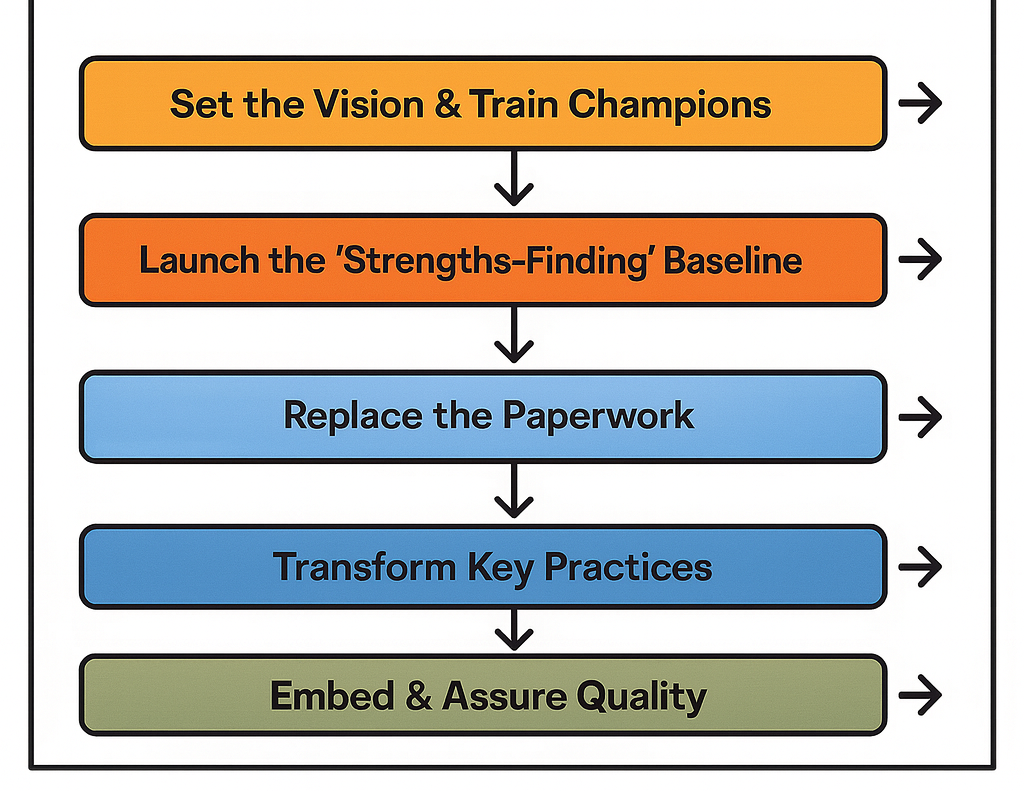
We recommend a 5-step approach to implementation, which can be phased over one to two academic years.
Diagram: The 5-Step DDP Implementation Roadmap
Part 3: The Implementation
Step 1: Set the Vision & Train Your Champions (Term 1)
You, as the leader, are the Chief Storyteller. You must introduce the "why" before the "what." This involves a formal launch, ideally in an INSET day, using the principles from Part 1 of this book and the foundational texts.
Crucially, you must immediately identify your "DDP Champions"—typically your SENCo, an SLT member, and a passionate pastoral lead. They will become your expert implementation team, responsible for training others and driving the process. They must be given the time and resources to succeed.
Step 2: Launch the 'Strengths-Finding' Baseline (Term 1)
Do not try to change everything at once. Pilot the DDP with a single cohort (e.g., your new Year 7 intake). Instead of the old deficit-based baseline tests, launch the 6-week "Strengths-Finding" Baseline (as detailed in our Assessment Procedures). This is your first "on the ground" action. Staff will learn by *doing*—by observing, talking to pupils, and co-creating the first DDPs.
Part 3: The Implementation
Step 3: Replace the Paperwork (Term 2)
Once your pilot cohort has their DDPs, you must make a symbolic change. You will formally replace the IEP (or equivalent) with the "Living DDP." This is a powerful cultural signal that "there is no going back." All systems—from your MIS to your staff meeting agendas—must now refer to the DDP as the single central document for pupil support.
Step 4: Transform Key Practices (Term 2/3)
With the new paperwork in place, you must change the *practices* that use it. The first and most important practice to change is the parent's evening. You will abolish the traditional model and introduce the "DDP Review Meeting" for your pilot cohort. This pupil-led, 3-way meeting is the DDP philosophy in action and will be your most powerful tool for getting parent buy-in.
Step 5: Embed & Assure Quality (Ongoing)
As you roll out the DDP to other year groups, your role shifts to quality assurance. Your DDP Champions and SLT must conduct regular moderations of DDPs, review DDP data, and ensure the strengths-based language is being used consistently by all staff. This is where you connect the DDP to staff performance management and your whole-school improvement plan.
Part 3: The Implementation
Working Document: Implementation Planner
Use this space to map out your first year.
- DDP Champions (Step 1): Who are your 3-4 key people for this? (e.g., SENCo, AHT Pastoral, Lead TA)
- Pilot Cohort (Step 2): Which year group will you start with? (e.g., Year 7 / Year 9)
- Key Dates (Step 1-4):
- Staff Launch INSET (Step 1): _________________
- First DDPs Co-Created by (Step 2): _________________
- Formal "IEP Switch-Off" Date (Step 3): _________________
- First DDP Review Meetings (Step 4): _________________
Part 3: The Implementation
Chapter 9: Transforming Your People
Roles, Training, and Morale
A philosophy is only as strong as the people who live it. The DDP is not a top-down instruction; it is a bottom-up cultural shift that empowers every member of staff. Your most important job as a leader is to manage this human change.
The DDP model does not just benefit pupils; it has a profound, positive impact on staff morale. It removes the "us vs. them" dynamic of punitive behaviour systems and frees staff from the "problem-fixer" role. It reframes their purpose as the much more rewarding role of "talent-spotter" and "skills-coach."
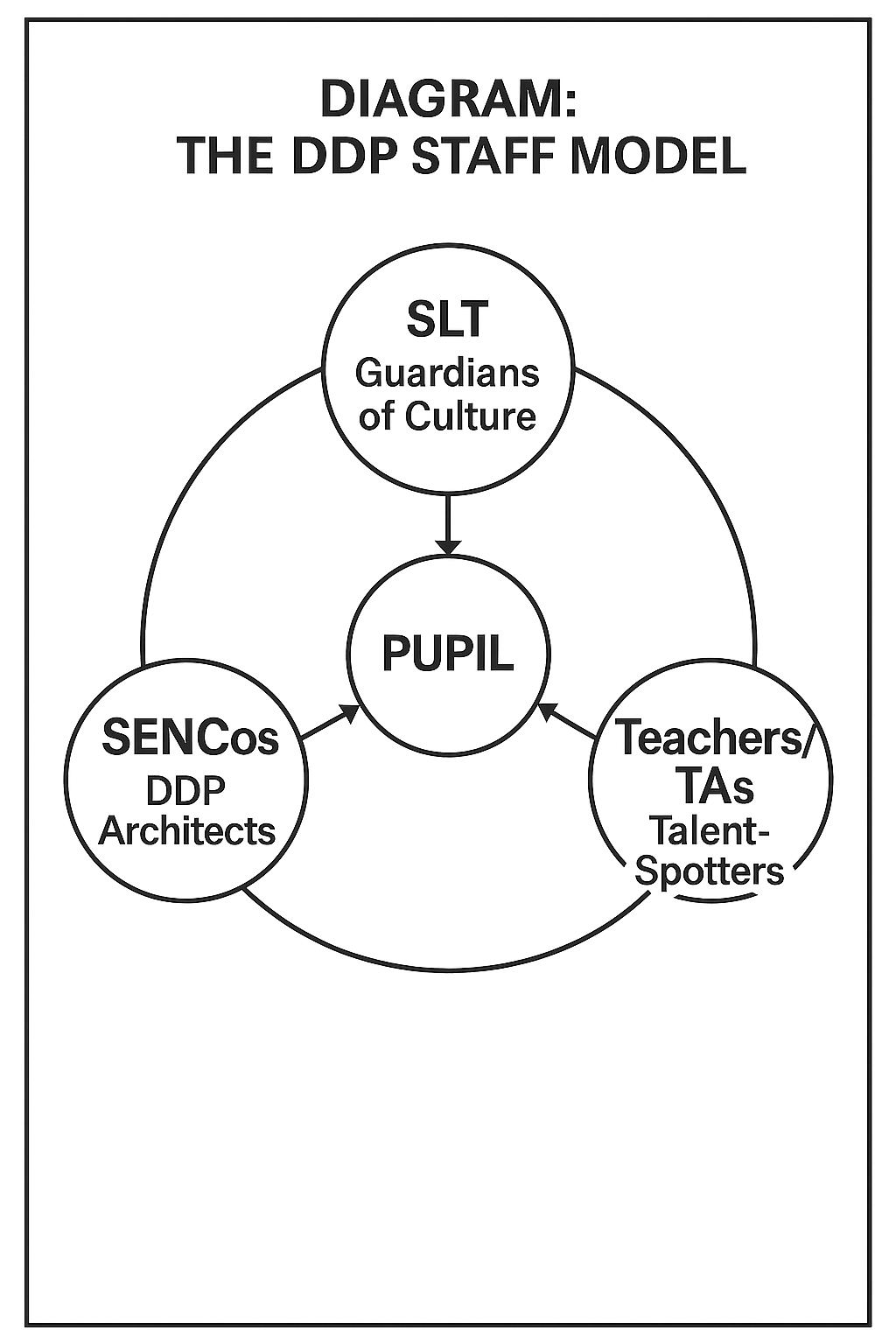
This chapter outlines the new roles and the training required to get there.
Diagram: The DDP Staff Model
Part 3: The Implementation
1. The New Role of the SENCo: The DDP Architect
This is the biggest role change. The SENCo's job is no longer to be the sole "gatekeeper" of SEND paperwork, chasing teachers for IEP reviews. The DDP elevates their role from administrator to strategic leader.
The DDP Architect's new role is to:
- Coach & Train: Run regular, informal training for TAs and Teachers on "talent-spotting" and writing good DDP goals.
- Quality Assure: Spend time reviewing DDPs, ensuring they are "living," strengths-based, and high-quality.
- Integrate: Liaise with therapists (SaLT/OT) to ensure their goals are integrated into the *single* DDP, creating a "common language."
2. The New Role of Teachers & TAs: The Talent-Spotters
Teachers and TAs are the frontline of the DDP. Their role is empowered; they are the experts on the pupil. Their new role is to:
- Observe & Identify: Actively look for "superpowers" in lessons.
- Use Strengths in Planning: Use the DDP as the *first* document they check in lesson planning, asking, "How can I use this pupil's 'logic' superpower to access this history lesson?"
- Update Dynamically: Formatively update the "Living DDP" in real-time.
Part 3: The Implementation
Working Document: Staff Training Audit
What training will your staff *need* to make this shift? This is not just a 1-hour INSET. This is ongoing coaching. This is your training plan.
| Training Module | Who is it for? | Who will lead it? |
|---|---|---|
| 1. The 'Why': From Deficit to Dynamic (The Philosophy) | All Staff | Headteacher |
| 2. How to "Talent Spot" (Finding Superpowers) | Teachers & TAs | DDP Champions |
| 3. How to Write a "Living DDP" (Co-creation with pupils) | Teachers & TAs | SENCo |
| 4. How to Run a "DDP Review Meeting" (Pupil-led) | All Staff | SLT / SENCo |
| 5. DDP & Behaviour: Reframing and Teaching Skills | All Staff | Pastoral Lead |
| 6. The DDP for SENCos: From Admin to Architect | SENCo/Champions | Headteacher |
Part 3: The Implementation
Chapter 10: Transforming Your Paperwork
The 'Living DDP' in Practice
Your paperwork *is* your philosophy in practice. Your old IEP template was likely a form that focused on "Problems," "Targets," and "Interventions." It was a static, deficit-based document. The DDP template is fundamentally different.
As a leader, you must ensure every DDP in your school adheres to these principles. On the next page is the detailed breakdown of the DDP One-Page Profile, which will replace your old paperwork.
Pupil Dynamic Development Plan (Example)
Review Date: 16/12/2025
My Superpowers (What I am great at)
- Logic & Systems: I love building complex LEGO and coding in Scratch.
- Being a Kind Friend: I am good at noticing when someone is sad.
- Amazing Memory: I can remember all the facts about dinosaurs.
My Goals for This Term
- (Academic) To use my 'Logic' superpower to help me structure my story writing.
- (Social) To use my 'Kindness' superpower to work with one other person on our Enterprise project.
- (Personal) To learn to spot when I am feeling overwhelmed and ask for a 5-minute 'movement break'.
How to Support Me (My words)
- "Let me use blocks or draw to plan first."
- "Give me clear 'First, Then' instructions."
- "Check in with me quietly, not in front of everyone."
- "I like knowing what's next."
Strengths & Passions
- Art & Drawing
- Minecraft
- Helping Mr. Smith
- Computers
- History
Signed (Pupil): ___________________
Signed (Parent/Carer): ___________________
Signed (Staff): ___________________
Part 3: The Implementation
Deconstructing the DDP Template
A Leader's Guide to the 'Why'
The DDP template on the previous page is not just a form; it is a pedagogical tool. Every section is designed to reinforce the Three Pillars of the DDP.
1. "My Superpowers" (Pillar 1: Strengths-Based)
This is the most important section. It is placed at the top to deliberately reframe the entire conversation. It is the first thing a pupil, parent, or staff member reads. It immediately sets a positive, strengths-based tone. It is the answer to the question "Who is this child?" not "What is this child's problem?"
2. "My Goals" (Pillar 2: Holistic)
We deliberately *do not* separate "Academic," "Pastoral," and "Therapeutic" targets. They are all "My Goals." This reinforces the holistic model. It shows how a personal goal (managing anxiety) is directly linked to an academic goal (focusing in class). It creates a "common language" for all staff, including therapists, to work from.
Part 3: The Implementation
3. "How to Support Me" (Pillar 3: Pupil-Led)
This section is the key to building self-advocacy. It is not a list of "TA interventions" written by an adult. It is co-written *with* the pupil, in their own words where possible. It is a list of practical strategies they have identified that work for them. This gives the pupil ownership and provides all staff with a clear, pupil-endorsed guide on how to provide support.
4. The "Living" Document (Pillar 2: Dynamic)
This one-page profile is just the summary. As a leader, you must ensure your staff use it as a "living" document (e.g., a shared digital file or MIS entry). Staff should add "WOW" moments—quick, dated notes of success—on a regular basis. For example: "15/11: David used his 'logic' superpower to help another pupil in Maths. Amazing teamwork!" This builds a bank of positive, formative evidence for the termly review.
Part 3: The Implementation
Working Document: Paperwork Transformation
Use this as your action plan for SLT.
- Action 1 (Design): Finalise our school's DDP template based on the new, more accessible 2-column model.
- Action 2 (Systems): How will this be stored? How will it be made "living"? (e.g., Google Drive, MIS, etc.) Who has access?
- Action 3 (Training): How will we train staff to *stop* writing deficit-based targets and start writing holistic, strengths-based, pupil-led goals? (Refer back to Ch 9).
- Action 4 (QA): As SLT, how will we "quality assure" the DDPs to ensure they are high quality and not just "new IEPs"? (e.g., termly sampling).
Use the space below for notes:
Part 3: The Implementation
Chapter 11: Transforming Your Practice
The DDP Review Meeting & Showcase
You have changed your paperwork. Now you must change the *practices* that use it. This is where the DDP becomes real for parents and pupils. There are two key practices you must introduce to replace the old, deficit-based model.
1. The DDP Review Meeting (Replaces Parent's Evening)
This is the most powerful tool for culture change you have. It is a 3-way, 30-minute meeting held termly, and it is led by the pupil.
The entire dynamic is different from a traditional parent's evening. The teacher is not "reporting on" the pupil. The pupil is the expert, "presenting" their DDP and their progress to their parents and teacher. The staff member's role is to be the "facilitator" and "chief celebrator."
This single practice builds pupil self-advocacy, creates a genuine parent partnership, and ensures the DDP is a "living" document. (See Appendix C for a full agenda template).
Part 3: The Implementation
2. The DDP Showcase (Replaces Summative Tests in KS3)
To make assessment holistic and strengths-based, you must change *how* you assess. In KS3, while still tracking progress, we replace the high-pressure, deficit-focused "exam week" with a "DDP Showcase."
This is a termly event where pupils present their work (e.g., a project, a presentation, a portfolio) to a small panel of staff and peers. The assessment is not just on the *work*, but on the pupil's ability to articulate *how* that work met their DDP goals.
For example: "My DDP goal was to 'use my creative writing superpower to explain complex ideas.' Here is the comic book I created that explains the water cycle."
This assesses the *whole child*—their academic knowledge, their communication skills, their personal goals, and their self-advocacy—all in one authentic, strengths-based event. (See Appendix B for an assessment rubric).
Part 3: The Implementation
Working Document: Practice Implementation
Think about the logistics of launching these new practices.
The DDP Review Meeting
- How will you timetable these 30-minute meetings? (e.g., in place of a parent's evening? Over a "review week"?)
- How will you train *pupils* to lead their own meeting? (This is a key teaching goal).
- How will you communicate this positive change to parents?
The DDP Showcase
- When would this happen? (e.g., last week of term?)
- Who would be on the "assessment panel"? (e.g., Key Staff, SLT, a peer?)
- What cross-curricular "vehicle" project will pupils use? (e.g., linked to the 'Enterprise' theme).
Part 4
The Golden Thread
The 'What'
Part 4: The Golden Thread
Chapter 12: The DDP-Powered Curriculum Plan
Beyond Subjects: A Vehicle for the DDP
In Part 2, you audited your curriculum and likely found it to be rigid and subject-led. This chapter provides the "how-to" for transforming it into a dynamic vehicle for delivering DDP goals.
A DDP-led curriculum is flexible, thematic, and cross-curricular. It provides constant, rich opportunities for pupils to *use* their "superpowers" and *practice* their holistic goals (e.g., "I am learning to work in a team") in an academic context.
At Elevated Futures, we developed a 5-year thematic model that does exactly this. It provides a "skeleton" on which to hang the National Curriculum subjects, ensuring all learning is contextual and purposeful.
Diagram: The 5-Year Thematic Journey
(A 5-stage flowchart:
Y7: Identify -> Y8: Community -> Y9: Enterprise ->
Y10: Employability -> Y11: Independence)
Part 4: The Golden Thread
The Thematic Model Explained
-
KS3 (Discovery): We focus on building identity and connection.
- Year 7 (Identify): All subjects explore "Who am I?" English lessons focus on autobiographical writing. Science explores "Ourselves." The "Identify Project" (PSHE) is where pupils co-create their first DDP and find their "superpowers."
- Year 8 (Community): All subjects explore "Where do I fit in?" History looks at local Southwark history. Maths uses local census data. Art explores local street art.
- Year 9 (Enterprise): All subjects explore "What can I build?" Maths focuses on budgeting and profit/loss. English is about persuasive language. DT is product design. This builds practical skills and financial literacy.
Part 4: The Golden Thread
The Thematic Model Explained (cont.)
-
KS4 (Application): We focus on accreditation and transition.
- Year 10 (Employability): All subjects link to the world of work. The DDP becomes the central careers (Gatsby) document. English focuses on CVs and interview skills. All pupils undertake meaningful work experience.
- Year 11 (Independence): All subjects focus on "What is my next step?" The DDP is used for post-16 applications and personal statements. The "Identify Project" focuses on managing exam stress and independent living skills.
Ofsted: Intent, Implementation, Impact
This model provides a powerful story for inspection.
- Intent: To provide a holistic, strengths-based curriculum that builds self-advocacy.
- Implementation: A 5-year thematic journey that uses the DDP as its "golden thread."
- Impact: Measured not just by grades, but by the "whole child" outcomes in the DDP and by successful, sustained post-16 destinations.
Part 4: The Golden Thread
Working Document: Your Curriculum Intent
Use this space to draft your new, DDP-led curriculum intent. Steal our language!
Example Draft: "Our curriculum is unashamedly ambitious. Its intent is to empower pupils to discover their unique strengths and prepare them for an independent future. We use the DDP as the 'golden thread' to weave academic and personal goals together, ensuring all pupils..."
Working Document: Your Themes
What themes would suit your school's context? (e.g., 'Heritage', 'Technology', 'Environment').
Part 4: The Golden Thread
Chapter 13: The DDP-Led Assessment Procedure
From Measuring Gaps to Celebrating Growth
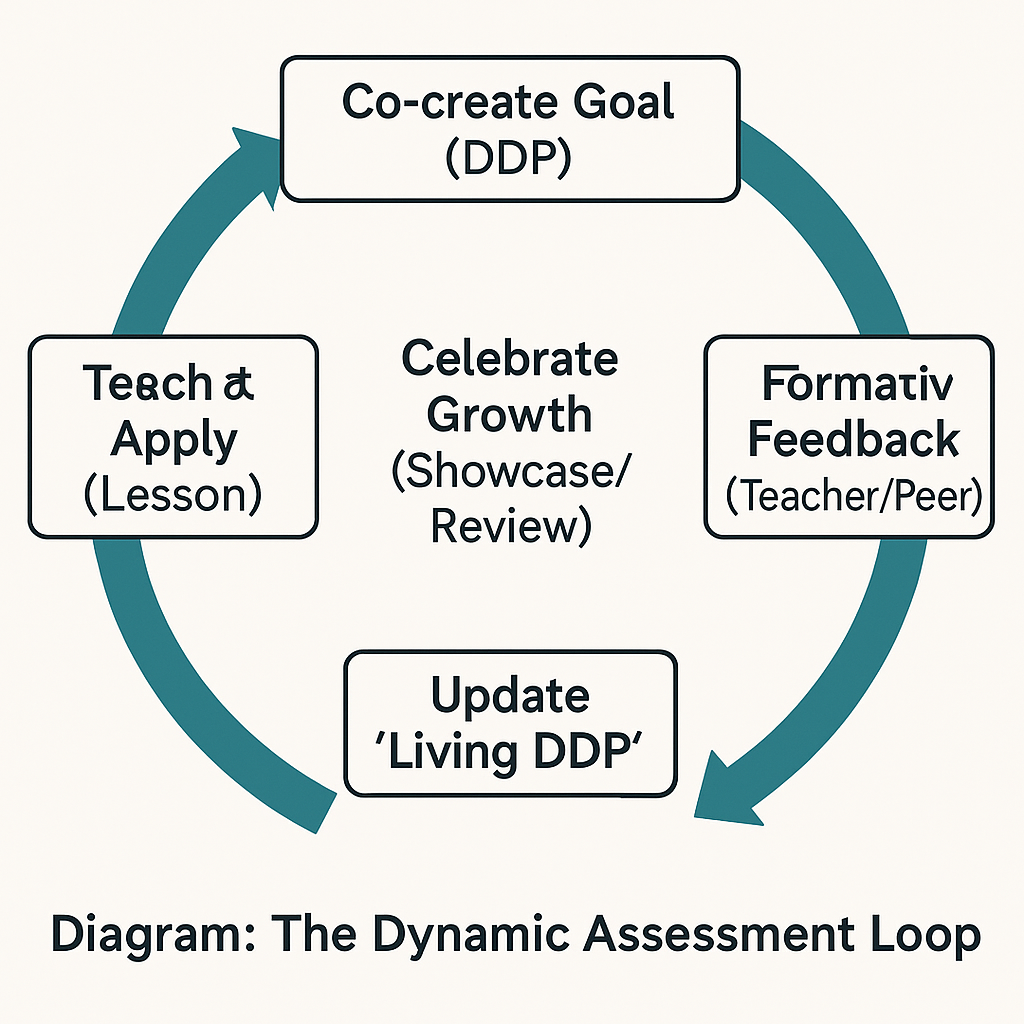
This is the engine of the DDP. Your Assessment Policy must be rewritten to reflect the three pillars. It must move from a deficit-based model (measuring gaps against age-related norms) to a dynamic model (measuring individual growth against DDP goals).
A DDP-led Assessment Policy is founded on formative assessment. It is a constant, low-threat loop of feedback that feeds the "Living DDP."
Your new policy must be built around the new, strengths-based practices you introduced in Part 3. The purpose of assessment is no longer just to "track data" but to "inform, celebrate, and build self-advocacy."
Diagram: The Dynamic Assessment Loop
Part 4: The Golden Thread
Working Document: Assessment Policy Transformation
Use this checklist to rewrite your Assessment Policy. Your goal is to move from the "Before" to the "After."
1. The Purpose of Assessment
- Before (Deficit): "To identify learning gaps and track progress against age-related expectations."
- After (Dynamic): "To discover and build upon pupil strengths, measure holistic growth against DDP goals, and build pupil self-advocacy."
2. Baseline Assessment
- Before: "On-entry screening tests to generate a baseline grade."
- After: "A 6-week 'Strengths-Finding' period of holistic observation to co-create the first DDP."
3. Reporting to Parents
- Before: "A termly data report of grades, attendance, and behaviour points, followed by a Parent's Evening."
- After: "The sharing of the 'Living DDP' followed by a pupil-led 'DDP Review Meeting' to celebrate progress and co-sign new goals."
Part 4: The Golden Thread
Chapter 14: The DDP-Informed Behaviour Policy
Reframing Behaviour as Communication
This is the most profound and challenging transformation for any school leader. You must move your entire staff culture from a punitive "behaviour management" model to a therapeutic "skills-teaching" model.
Your new policy must be retitled. It is no longer a "Behaviour Policy." It is a "Relationships & Self-Regulation Policy."
The core statement of this new policy, which must appear in the first paragraph, is:
"We believe that all behaviour is communication."
This single sentence changes everything. It means a "disruptive" pupil is no longer a problem to be "managed," but a child communicating an unmet need or a lack of skill. The school's job is not to punish the communication, but to understand the need and *teach* the skill.
Part 4: The Golden Thread
Reframing the Process
A DDP-led Behaviour Policy does not have a "Ladder of Consequences." It has a "Ladder of Support." It is not about sanctions; it is about teaching.
The "deficit" model asks: "What rule was broken? What is the sanction?"
The "dynamic" model asks: "What is this pupil communicating? What skill do they need? How can we teach it?"
This means the DDP is the central tool for behaviour. When a pupil struggles, the response is not just a detention. The response is to update the DDP.
Example: A pupil shouts and walks out of class.
- Deficit Response: "That is a C3. You have an after-school detention."
- Dynamic Response: A restorative conversation. A new, co-created DDP goal is added: "I am learning to recognise when I am overwhelmed (Pillar 3) and to ask for a movement break (Pillar 1) so I can stay in class (Pillar 2)."
The focus shifts from punishment to teaching the skill of self-regulation. This is the only approach that creates lasting change.